1
posts
2
Why are there so many lizards in Australia? The ancient climate holds a clue
If you travel around Australia, you will find an incredible diversity of lizards.
The three-toed snake-tooth skink (Saiphos reticulatus), for example, is a peculiarly long and stumpy legged reptile that burrows in rainforest and is covered in a brilliant orange and black-banded pattern. Alpine water skinks (Eulamprus kosciuskoi) are incredibly cold-tolerant and mottled with black and greenish yellow, like mossy rocks in mountain streams. Prickly forest skinks (Concinnia queenslandiae) are delightfully chunky-headed, spiky, armoured rainforest gems.
These lizards are all members of Australia’s largest evolutionarily related group of vertebrate animals, known as the Sphenomorphini. Their ancestors arrived in Australia some 28 million years ago, likely crossing land bridges and rafting across islands from Southeast Asia during glacial periods when sea levels were lower.
In a new paper, colleagues and I describe the most complete and detailed evolutionary tree of this group to date. This helps us to understand why there is such a mountain of species diversity within this group. A crucial clue is in the climate.
Three-toed snake-skink (Coeranoscincus reticulatus). nicgambold/iNaturalist, CC BY-NC
Building the evolutionary tree
Previous estimates in Sphenomorphini lizards concluded there were about 270 species in the group.
For our new study, we gathered more than 5,000 genetic identifiers to build a “species tree” of the entire group that reveals a total of at least 314 member species.
Our evolutionary tree shows most modern Sphenomorphini genera in Australia seem to appear in a six-million-year burst.
The timing of this burst is telling. It coincides with the Early Miocene – a climatically tumultuous period roughly 23 million to 16 million years ago, marked by the expansion of Antarctica’s ice sheets.
Australia, which by then had broken off from the southern supercontinent of Gondwana, saw a significant reduction in rainfall. As rainforest declined, the continent became more arid.
This suggests climatic changes may have driven the diversification of Sphenomorphini, with new species forming in response to the changing conditions.
This raises the question: how exactly did the new species form?
While several processes are known to drive the evolution of new species (such as sexual selection and competition), two major forces appear to be crucial to the story of the Sphenomorphini.
One is known as “allopatric speciation”. This is when a new species forms by the simple physical splitting of a population. Over millions of years, each population accumulates enough mutations via simple chance that if they were ever to meet again they would be too different to interbreed.
The second major force is known as “ecological divergence”. This is when populations of a single species develop niche traits in response to different environmental conditions. The populations now have differing selective pressures. Eventually, they stop mating with each other and enough different mutations accumulate to create an entirely new species.
The exact role of each of these forces is still unclear and will be the focus of our future research.
Alpine water skink (Eulamprus kosciuskoi). calamanthus/iNaturalist, CC BY-NC
Heeding the warnings
Lizards are a massive component of the storied history of life on this planet. Now that we are slowly unravelling the mysteries of their evolution, we should perhaps heed the warnings.
In the Sphenomorphini, the details seem to paint a picture of arrival, climatic change likely accompanied by extinction and diversification, and for some, persistence in the face of a changing environment.
But bear in mind, the climate shifts that upended the Australian rainforest domination and led the Sphenomorphini to generate such diversity were incredibly slow.
Much changed in the 12 million years between the so-called early Miocene and middle Miocene climatic events. Yet global temperatures only declined around 2°C–3°C.
An equivalent degree of warming in only a mere few centuries would likely be catastrophic for these remarkable creatures – along with so much other life on Earth.


3
Banner image: A black crowned crane (Balearica pavonina), which is found within the African-Eurasian flyway. Image by H. Zell via Wikimedia Commons (CC BY-SA 3.0).
Up to half the bird species using the African-Eurasian flyway are declining
- Every year, billions of birds migrate long distances with the changing of seasons — according to BirdLife Africa, 40 to 50 percent of avian species migrating to and from Africa are in decline.
- BirdLife Africa’s Kariuki Ndang’ang’a says climate change and infrastructure collision stand as three of the main reasons for the decline in migratory bird species.
- Because many birds rely on the same sites each year to make their transit, loss or degradation of even small areas can push an entire population towards collapse.
Each year in May, World Migratory Bird Day draws attention to the billions of birds that migrate long distances with the changing of the seasons, a living braid of ecosystems separated by thousands — even tens of thousands — of kilometers. According to Kariuki Ndang’ang’a, BirdLife International Africa’s regional director, about 2 billion birds fly along the African-Eurasian flyway every year: the populations of between 40 and 50 percent of these migratory bird species are in decline.
Ndang’ang’a told Mongabay added that the birds that travel furthest are at greatest risk. Some species, like Abdim’s stork (Ciconia abdimii), migrate relatively short distances within the continent, but palearctic migrants — those coming from distant landscapes in Europe or Asia — are particularly vulnerable, experiencing over a 30% decline in the past 30 years.
“Because these birds depend on specific stopover sites (like Lake Chad or the Nile Delta), the loss of even one small wetland can cause an entire population to collapse,” Ndang’ang’a wrote in an email.
Abdim’s stork at Masai Mara NP, Kenya. Image by tsowerby via iNaturalist (CC BY-NC 4.0)
According to Ndang’ang’a, habitat loss, climate change and infrastructure collision stand as three of the main reasons for the decline in migratory bird species.
“For instance, the drainage of wetlands for agriculture or urban expansion has greatly affected migratory birds as they search for resting and feeding ground,” he said. Lake Chad, on the southern edge of the Sahara Desert, has lost 90% of its surface area since the 1960s, depriving millions of birds such as the European roller (Coracias garrulus) a refuge.
Climate change presents another challenge for migrating birds, he said.
“Rising temperatures cause ecological mismatches where birds arrive at breeding grounds after their primary food sources (like caterpillars) have already peaked. The European warblers have ended up reaching their breeding grounds in poor condition because the Sahel wetlands in Africa are drying up earlier than usual due to changing rainfall patterns.”
“Thirdly, poorly manned infrastructure such as power lines and wind turbines cause thousands of deaths annually for large soaring birds like storks and raptors, which often follow [fly along] specific mountain ridges or valleys where wind farms are built,’’ he added.
Egyptian vulture at Mishraq Shewa, Ethiopia. Image by Paul G. Schrijvershof via iNaturalist (CC BY-NC-ND 4.0)
Paul Matiku, the executive director of conservation NGO Nature Kenya, says there are several successful projects aimed at preventing the death of migratory birds from collisions with energy infrastructure.
“For instance, in the intervention at the Gabal-el Zayt wind farm in Egypt, conservationists and engineers use a protocol to temporarily stop wind turbines when large flocks of migratory birds are detected approaching the site. This has significantly reduced the mortalities of birds such as the white stork from collisions without causing substantial power losses to the grid.”
In Sudan and Ethiopia, power lines have been retrofitted with visibility markers and insulation to prevent the electrocution of species like Egyptian vultures (Neophron percnopterus).
“In Kenya, Nature Kenya worked with Birdlife International and government partners and produced wind power strategic environment assessment report which helps to map places that are most important for migrating birds and which should be avoided during wind power placement,” Matiku said.
Nature Kenya has also enlisted residents of local communities with first hand knowledge of the most common places where birds fall victims of power lines. The NGO provides training for site support groups to gather better information to guide the relevant authorities to rethink powerline design.
From Africa to Central Asia, the European roller’s migration builds relationships
BirdLife SA's tiny staff dedicated to the European Roller Monitoring Project is supported by the Royal Society for the Protection of Birds. The tracking devices are paid for by individual donors. Image courtesy of Lourenço Afonso.
World Migratory Bird Day’s May date has been chosen to coincide with the peak migration period for birds using not only the African-Eurasian flyway, but others linking East Asia to Australia or North to Central and South America.
“Migratory birds connect continents,” said Blessings Chingagwe, who works for one of BirdLife’s partners, Wildlife and Environmental Society of Malawi in March.
“A bird feeding at Chia Lagoon may have travelled thousands of kilometres from Europe or Asia. If just one important wetland along the flyway is lost or degraded, it can affect populations across multiple countries. Protecting wetlands in Malawi is part of protecting a global ecological system.”


4
Banner image: Awareness of leopard cats is generally low across their range, as they are small, difficult to spot, and are sometimes mistaken for domesticated cats or leopard cubs. This one was photographed in the Sundarbans mangrove forest of West Bengal state, India. Image by Soumyajit Nandy via Wikimedia Commons (CC BY-SA 4.0).
Asia’s mainland leopard cat is abundant but still cloaked in mystery
- Widespread, adaptable, and classified globally as a species of “least concern” on the IUCN Red List, the mainland leopard cat can be found across much of Asia. However, research on the species remains relatively limited.
- Despite its global status, local populations face serious threats — including habitat loss, hunting, vehicle collisions, and genetic isolation — and in some cases are considered locally critically endangered. Global assessments can mask these regional declines due to how conservation status is assessed.
- Researchers highlight knowledge gaps caused by underfunding, language and geopolitical barriers, along with unshared data. They stress that more focused studies, genetic research, and conservation initiatives that involve local communities are essential to protecting this ecologically important species.
There’s good news about Asia’s mainland leopard cat: Prionailurus bengalensis is thought to be one of the world’s most abundant, widely distributed wildcats. With a conservation assessment of “least concern” on the IUCN Red List, sightings are reported from India to the Russian Far East.
That’s partly because mainland leopard cats are highly successful generalists. With two recognized subspecies — P. b. bengalensis and P. b. euptilurus — this small cat is adaptable to multiple habitats, ranging from forest to shrublands to grasslands, and including areas altered by humans.
But this good news comes with a caution: Surprisingly little is known about this felid, say experts, and it may be less plentiful and more at risk than sightings alone indicate.
Leopard cats have been understudied, a trend common among small cat species, which garner less public interest than big cats, and a reality that translates into less funding for research and conservation. As a result, P. bengalensis population surveys have only been conducted at a handful of sites, leaving lots of blank spots on range maps.
Despite perceived abundance, researchers note that this felid also still faces conservation challenges and could benefit from more attention from funders and the public, as the species plays an important, if underappreciated, role in controlling rodent populations.
A leopard cat in the Russian Far East, where it lives alongside leopards and tigers but receives relatively little attention compared with its larger, dynamic cousins. Image courtesy of Yuriy Smityuk.
Of ‘least concern’ but at risk of local extinctions
Roughly the size of a domestic cat, Asia’s mainland leopard cat was first recognized as a distinct species in 2017, when recent molecular studies and morphological differences led scientists to list it separately from the Sunda leopard cat (Prionailurus javanensis) found on Southeast Asian islands.
The mainland leopard cat’s conservation status was most recently assessed for the IUCN Red List in 2021 by an international team of researchers, who, based on available evidence, determined that the species’ overall population and range “have remained more or less the same.”
However, country-level data on leopard cat populations, as with many smaller mammals, is spotty or generally does not exist, says Priya Singh, an India-based independent researcher and one of the IUCN assessment leaders.
“We have standalone studies, which cover small areas, and then based on those studies we have to extrapolate and make intelligent guesses about what the population of that species would be at a larger level,” Singh says.
IUCN 2022 Leopard cat (Prionailurus bengalensis) distribution map. While considered one of the most abundant widely distributed small cats, and given a “least concern” listing by the IUCN, detailed P. bengalensis population data don’t exist for many locales and the species may be at risk, or even locally extinct, in some places. Image by Embladc via Wikimedia Commons (CC BY-SA 4.0).
The design of the Red List framework can sometimes create misperceptions about actual conservation status, says Thomas Gray, tiger recovery lead at the WWF Tigers Alive Initiative, who was involved with the Red List assessment for the mainland leopard cat.
That’s because IUCN Red List assessments are based on a species’ three most recent generations, or a minimum of 10 years. “This shifting baseline means that some of the big declines in animal abundance that will have been caused by habitat loss over the past 30 years are kind of irrelevant in Red List assessments now,” Gray adds.
“You can [also] have situations where a species may be critically endangered in a place, may be extinct in [another] place, but its global conservation status remains ‘least concern’ because what we are looking at [with the Red List] is global, range-wide trends of population,” he says.
Critically endangered local leopard cat populations include those on Japan’s Tsushima and Iriomote islands, each of which hosts roughly 100 of the cats. Conservationists warn too that habitat loss and human activities have reduced leopard cat numbers in Taiwan, where fewer than 500 individuals remain, putting it perilously close to local extinction.
Alongside the 2021 Red List survey, the mainland leopard cat is also currently being assessed for the IUCN’s Green Status of Species, an additional evaluation that classifiers introduced in 2021 to measure the extent to which a species is depleted or recovered.
The Green Status is intended to address gaps in the Red List framework “by considering regional status, recovery status, and conservation impact,” explains Elliot Carlton, a species survival officer with the IUCN SSC Centre for Species Survival Cats.
He highlighted the example of the European wildcat, another small felid that was assessed to be of “least concern” for global extinction based on the Red List framework, yet whose Green Status assessment was found to be “largely depleted.”
“Hopefully, the Green Status assessment will provide insights into the differences in status, threats, and data quality across the mainland leopard cat’s range,” Carlton says. “I hope that, together with the Red List, the Green Status can highlight where further research efforts are needed and support planning for the species.”
A leopard cat in India’s West Bengal state. India’s population of leopard cats is not contiguous, with individuals in the western part of the country isolated from the rest of the leopard cat’s range. Image by Soumyajit Nandy via Wikimedia Commons (CC BY-SA 4.0).
Challenges to data gathering
Researchers, including IUCN collaborators making overall assessments, are confronted by many challenges in their attempts to study leopard cats, not least of which are the sociopolitical workings of human society that can vary widely between the 19 countries over which the cat’s range extends.
Language barriers are one factor that can hinder information sharing, with hundreds of languages spoken across the small cat’s far-flung territory, ranging from Mandarin Chinese to Russian, Hindi-Urdu to Nepali and Japanese. In addition, Northeast Asia tends to be underrepresented in Red List assessment teams, which primarily work in English, Gray says. As an example, he cites the “huge amount of very high-quality research that happens in China,” but which might not be fully incorporated into IUCN assessments.
Geopolitical tensions also create blind spots that hinder surveys and conservation planning. “Almost nothing is known about leopard cat populations in North Korea,” notes Kyungmin Kim, a postdoctoral researcher at the Research Institute of EcoScience at Ewha Womans University in South Korea.
“Recent research suggests that indiscriminate snaring is widespread across North Korea, with leopard cats reported as bycatch in this process,” she says, adding that some studies have indicated worrisome state involvement in illegal wildlife trafficking.
Anonymous Japanese illustration of a wildcat, identifiable as a leopard cat (Prionailurus bengalensis). The species also appears in India on a postage stamp. Image by Anonymous from Honzō kōmoku (Japanese edition of Jōō 2/1653) via Wikimedia Commons (Public domain).
The extreme case of North Korea aside, other countries in the leopard cat’s range have less-than-stellar transparency records, though it’s unlikely governments hinder the sharing of knowledge about the species, according to Gray.
“For species that are highly politically significant and/or have had lots of money invested in them, it can be extraordinarily difficult to get the data you need,” he says. “For the leopard cat, it’s not as if no one cares, but for species [of] ‘least concern’ globally, there are no political concerns.”
Another problem: Data on leopard cats garnered during studies of other species, known as bycatch data, sometimes remain unshared and unutilized, says Yadav Ghimirey, director of Friends of Nature Nepal and first author of the Red List assessment for the mainland leopard cat.
“There are some organizations that do a lot of field work but publish only on some species. But camera trapping and other surveys provide data for a lot of other [bycatch] species as well,” Ghimirey says. He notes that this bycatch data could be shared with students and researchers to help governments with conservation planning.
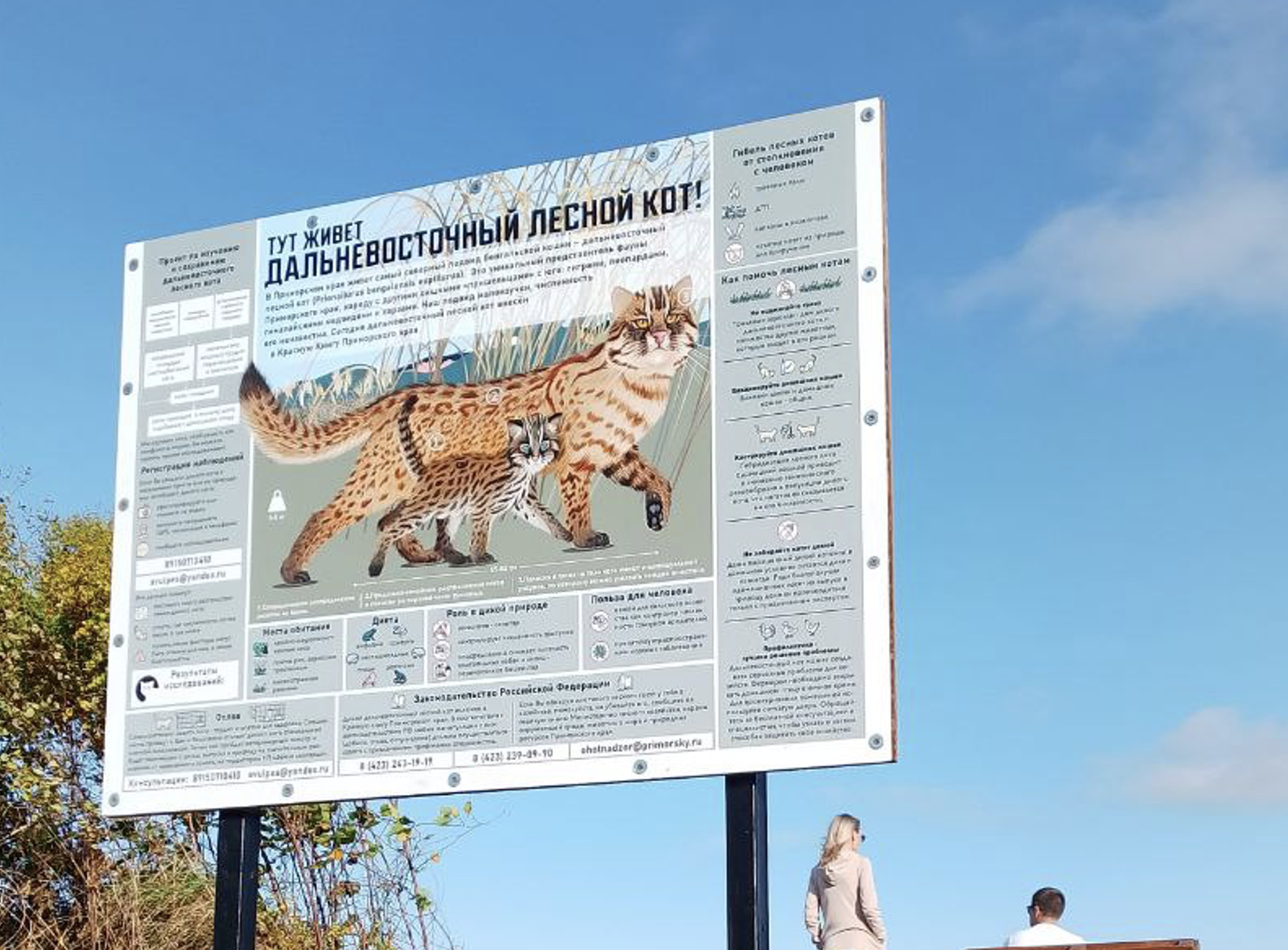
A sign placed to educate local communities in the Russian Far East about the mainland leopard cat. The more people know about this small wildcat, say researchers, the more likely they are to appreciate it and aid in its conservation, and the less likely human-cat conflict may be. Image courtesy of Ekaterina Blidchenko.
Conservation threats and opportunities
While mainland leopard cats may be far from global extinction, the species does face numerous threats.
Among the most vulnerable are “island populations,” which include cats inhabiting actual islands, and those outside the species’ contiguous range on the mainland, such as the leopard cats of India’s Western Ghats region, Singh says. She notes that these isolated populations face risks related to inbreeding. “They are the ones that could end up losing out on their actual conservation or threat status when we do this wide-scale assessment.”
Vehicle strikes are also a common issue, especially as the cats’ habitat becomes increasingly fragmented by road construction. In addition, the IUCN Red List notes that “hunting and snaring occur in most parts of [the] Mainland Leopard Cat’s range and is particularly intense in South-east Asia.” The cat is also traded or hunted for its meat and fur, as well as for illegal adoption, domestication, and hybrid breeding, in parts of its range.
Another threat: conflict with humans over poultry, which leopard cats have been known to snatch. But in the Russian Far East, conservationists are meeting with success in dealing with these human-cat conflicts, says Ekaterina Blidchenko, a senior research assistant at Kedrovaya Pad State Biosphere Nature Reserve and at Land of the Leopard National Park.
A Prionailurus bengalensis kitten in Taiwan, where only 500 leopard cats remain. Taiwan’s leopard cats are among several “island” or isolated populations facing greater local extinction threats than the species overall. Image by ourskyuamlea via Pixabay (Public domain).
Blidchenko’s team developed a signboard to educate local farmers about the leopard cat and involve them in conservation. Placed in more than 10 villages adjacent to national parks, the signs offer contact information to local people interested in cat-proofing their poultry pens or requesting humane cat relocations. “People are increasingly resorting to humane methods of capturing leopard cats visiting chicken coops,” she says.
“[T]he leopard cat very often encounters people in anthropogenic landscapes (highways, agricultural lands, poultry houses), unlike large cats such as tigers and leopards. So it is very important to work with people to highlight the importance of preserving this species of small cat and its valuable place in the ecosystems of Northeast Asia,” Blidchenko adds.
The signs her team have placed in local communities also invite individuals to submit information on leopard cat sightings, which will help researchers map the cat’s range and populations, as well as improve understanding of threats.
Involving local communities is key to conservation, particularly outside of protected areas, Singh agrees. In her experience, “anyone who sees a wild cat — whether it’s big or small — out in the wild gets excited, whether it’s tourists or people working in their fields.”
Due to its large range, transboundary collaboration is key to understanding and conserving the mainland leopard cat. The IUCN Red List and




5
The golden-headed lion tamarin, captured in the photo above, is a small primate species found only in the northeastern Brazilian state of Bahia.
The tamarins, Leontopithecus chrysomelas, have bright reddish-golden manes, and similarly colored paws and tails. They live among tree branches, eating fruit and the occasional bird egg or small vertebrate. They sleep huddled together with their extended family units in tree holes.
Flávia Zagury, a biologist and photographer, photographed a family of tamarins at the Primatology Center of Rio de Janeiro, a state research center with a mission to preserve Brazil’s primate heritage.
“I was so impressed by this creature, their colors are incredible,” Zagury told Mongabay in an audio message. “[The tamarins] were vocalizing a lot … I sensed a lot of curiosity coming from them.”
These tamarins are among Brazil’s most threatened primates, having faced a nearly 60% population decline in just three decades. From 1992 to 2024, agricultural and urban expansion took over more than 40% of their habitat. Now, they have just 13,000 square kilometers (5,000 square miles) of available forest, and much of it is fragmented.
A large part of the existing range of the tamarins is made up of cacao agroforestry farms called cabrucas, where the crop is grown underneath a canopy of native trees. Luckily, cacao is also one of their favorite fruits.
In recent years, coffee monocultures and livestock pastures have taken over many cacao farms, adding to the primate’s extinction risk. Locals have been working to better protect them: the city of Ilhéus in Bahia made the golden-headed lion tamarin its official mascot to raise awareness in 2024 and increase local pride for sustainable cacao farms. A rehab center was also inaugurated in March 2026 to help reintroduce tamarins found in urban spaces back into the wild.
“My next mission is to see them in the wild,” Zagury said.
Banner image: A golden-headed lion tamarin (Leontopithecus chrysomelas). Images courtesy of Flávia Zagury.

6
7
8
9
10
11
12
Why these toads are evolving faster than anyone expected
An invasive cane toad (Rhinella marina) is measured in Australia. (Chris Barlow / Macquarie University via SWNS)
By Stephen Beech
Cane toads have leapt ahead of evolution theories by growing bigger and changing more rapidly than expected, according to new research.
The invasive species has bulged in size since being introduced into Japan less than 50 years ago, reveals the study.
Scientists say their findings suggest environmental pressures can drive rapid biological change.
The study comparing invasive cane toads in Japan and Australia found "substantial" changes in body size and shape have developed much more rapidly than suggested by long-held ideas of the pace of evolution.
Researchers measured and weighed wild-caught cane toads on Ishigaki Island in southern Japan and compared them to toads measured in Australia, Hawaii and South America.
A large cane toad outside. (Photo by Flávio Santos via Pexels)
The most striking difference was in body size with adult toads from Ishigaki weighing an average 190 grams (0.4 lbs) compared to 135g (0.3 lbs) for toads from Australia, while their average length was 122 millimeters (4.8 inches) compared to 111mm (4.3 ins).
The findings, published in the journal Royal Society Open Science, also showed that Ishigaki toads had wider heads, shorter arms and longer legs than toads from other locations.
Cane toads have spread to more than 40 countries worldwide from their ancestral habitat in north-eastern South America.
They first spread to Puerto Rico and then to Hawaii and from there to Australia in the 1930s.
The toads of Ishigaki were introduced from Hawaii, via Taiwan and the Daito Islands, in 1978.
Senior researcher Rick Shine said: "Given these populations of toads in Japan and Australia shared a common history in Hawaii until the 1930s, these differences in size and body shape have developed in less than 100 years.
"The idea that evolutionary change happens at a glacially slow pace is being challenged by recent evidence showing rapid changes in species confronted with novel challenges, like being translocated to a different habitat."
The study didn't collect sufficient data to allow researchers — from Macquarie University and the University of Sydney in Australia plus Kyoto University in Japan — to test alternative theories about what might be driving the changes in body size.
But the research team speculated that the larger body sizes of Ishigaki toads could reflect favorable climatic conditions, particularly year-round rainfall or the impact of lower pressure from predators on the island.
Shine, an evolutionary biologist and ecologist at Macquarie University in Sydney, added: "We don't have a clear idea of the evolutionary forces that might be involved, so we can't say why body mass and shape has changed among the toads in the Japanese system."


13
Some rays flash decoy eyes while others never do, as evolution's hidden trade-off comes into focus
(phys.org)
Some rays flash decoy eyes while others never do, as evolution's hidden trade-off comes into focus
Pacific Starry Skate. Credit: Andy Murch.
From butterflies to peacocks, bold circular "eyespots" are among nature's most eye-catching patterns. But why do they appear in some animals and not others? A new study of skates and rays finally provides an answer—and it lies in the full range of defenses an animal has at its disposal.
In a study examining more than 580 species—over 90% of all known skates and rays—researchers from Stockholm University have mapped the evolutionary history of conspicuous markings across this ancient group of cartilaginous fishes.
By analyzing multiple anti-predator defenses together, rather than studying eyespots in isolation, they were able to explain why such dramatic visual signals appear in some groups but are completely absent in others. The work has been published in Nature Ecology & Evolution.
"Our results show that you have to look at the full range of options for avoiding predators. Eyespots evolve only under certain ecological and defensive conditions. They are one solution among many in the evolutionary arms race between predator and prey," says lead author Madicken Åkerman.
Mediterranean Rough Skate. Credit: Andy Murch
Rasptail Skate. Credit: Andy Murch.Different species, different toolkits
Skates and rays face a wide range of predators, including sharks, marine mammals and large fish. Some species defend themselves with powerful electric organs or venomous spines. Others rely more heavily on camouflage, burying themselves in sand on the ocean floor.
The researchers found that species equipped with such robust defenses rarely evolved conspicuous markings. In contrast, smaller-bodied species without those weapons were much more likely to develop bold spots or eyespots—particularly if they lived in well-lit, shallow waters less than 200 meters deep.
"Eyespots are far from random. They tend to evolve in species that lack strong physical defenses, such as venomous tail stings or electric shocks, and that live in bright, shallow waters where visual signals are effective," says senior author John Fitzpatrick.
John Fitzpatrick at Stockholm University. Credit: Anette Gärdeklint Sylla/Stockholm University
"Evolution seems to favor different defensive toolkits. If you already have a strong mechanical or electrical defense, you don't also need a visual warning signal," says Madicken Åkerman.
A stepwise process
The study also uncovered a surprising evolutionary pattern: eyespots almost never evolved directly. Instead, species typically first gained simpler markings—such as bold spots—which were later refined into the classic concentric-ring eyespots seen in some skates. In evolutionary terms, gaining simple markings was about 100 times more likely than gaining eyespots outright.
"It appears to be a stepwise process. Other markings come first, and over time they refine into eyespots," says John Fitzpatrick.
Yet conspicuous markings are also frequently lost. This makes sense when considering the trade-off at play. In deep, dark waters where little light penetrates, a visual signal cannot be seen—and therefore offers no protection. Under those conditions, the cost of being conspicuous outweighs the benefit—and the markings disappear.


14
How Namibia’s bird conservation projects build community resilience (commentary)
(news.mongabay.com)
Banner image: Lilac-breasted roller in Etosha National Park, Namibia. Image courtesy of Giles Laurent via Wikimedia Commons, CC BY-SA 4.0.
How Namibia's bird conservation projects build community resilience (commentary)
- Droughts and land degradation often erode communities’ social bonds, but in the Karas region of Namibia, bird conservation initiatives have become a rallying point.
- Women and youth are at the forefront of these initiatives, which has inspired confidence among peers and shown that conservation is not the domain of scientists alone, but also a practice of everyday community resilience.
- “It is time for policymakers, NGOs, and donors to support these initiatives not just as biodiversity projects, but as investments in community well-being,” a new op-ed argues.
- This article is a commentary. The views expressed are those of the author, not necessarily of Mongabay.
In Namibia’s Karas Region, birds are more than symbols of freedom or beauty — they are teachers of resilience. Their survival in arid landscapes mirrors the endurance of the communities who live alongside them. Grassroots bird conservation projects here have revealed something profound: protecting birds can also strengthen families, nurture hope, and build social cohesion.
Across villages in Karas, parents and children tend habitats together, restoring nesting sites and planting native vegetation. These acts of care are not only ecological interventions; they are lessons in patience and problem solving. When a child sees a weaverbird return to a reed bed that the community has protected, it is a moment of triumph that teaches perseverance in the face of environmental challenges.
Women and youth are at the forefront of these initiatives. In one community, a group of young women organized bird walks for schoolchildren, teaching them to identify species like the sociable weaver and the pale chanting goshawk. Their leadership has inspired confidence among peers and shown that conservation is not the domain of scientists alone — it is a practice of everyday resilience.
Sociable weavers nesting in acacia trees, Karas Region, Namibia. Image courtesy of Martha Karas.
These projects also counter the isolation that environmental stress can bring. Droughts and land degradation often erode social bonds, but bird conservation has become a rallying point. Families gather to monitor nesting sites, share stories, and celebrate small victories. In doing so, they weave resilience into the social fabric. Conservation here is not only about biodiversity; it is about belonging.
The ecological benefits are clear. Protecting bird habitats safeguards pollination, seed dispersal, and pest control — services that sustain agriculture and livelihoods. But equally important is the emotional strength these projects cultivate. In Karas, conservation has become a human resilience strategy: a way to confront uncertainty with collective action and hope.
This perspective challenges the conventional view of conservation as a technical exercise. Too often, policies focus narrowly on species counts or protected areas. While these metrics matter, they overlook the lived experience of communities who find strength in caring for nature. By recognizing conservation as both ecological and social, we broaden its value and deepen its impact.
Lappet-faced vultures like this are native to the arid plains of the Karas Region, and organizations like Vultures Namibia ensure there’s awareness of them. Image courtesy of Martha Karas.
The lesson from Karas is urgent. As climate change intensifies, resilience will be as critical as resources. Grassroots bird projects show that resilience can be cultivated through simple, shared acts of care. They remind us that conservation is not only about saving species, but about sustaining the human spirit.
It is time for policymakers, NGOs, and donors to support these initiatives not just as biodiversity projects, but as investments in community well-being. Funding should prioritize programs that empower women and youth, foster intergenerational learning, and strengthen social bonds through conservation.
Birds in Namibia’s Karas Region are survivors of harsh landscapes. But they are also mentors of resilience, teaching us how to endure, adapt, and thrive together. By listening to the voices of those who lead grassroots efforts, we can reimagine conservation as a strategy for human strength as much as ecological survival.
Supporting these projects is not charity — it is foresight. In every nest protected, in every child inspired, we see the seeds of resilience that will carry communities through the challenges ahead.
Conservation, at its best, is a story of hope. And in Karas, that story is being written by birds and the people who care for them.
Martha Karas is a Namibian writer based in the Karas region.


15
If you are ever confronted by a toad, you soon see why there is little chance of confusing it with its froggy cousin.
I realised this after discovering a glorious, warty specimen settled on damp concrete in the garage one autumn. It was not only its copper-coloured eyes, squat boxer face and bumpy, waterproof skin — allowing it to survive away from water for longer — but its size that impressed. Wild toads can live for more than a decade; this creature may have been as old as my son.
After some deliberation (and Googling) I moved my toad to a pile of logs and fallen leaves near the pond. It was silent as I transported it, in gloved hands to protect its skin from mine, which meant it must have been a female: only male toads squeak when picked up.
Sadly, a report recently found that the chance to perform a toad relocation may become rarer than ever. Led by Dr Silviu Petrovan of the University of Cambridge in collaboration with the charity Froglife last October, it used one of the biggest data-sets ever gathered for amphibian population trends; between 1986 and 2021, a dedicated team of volunteers counted migrating toads during the spring breeding season. The findings were sobering: over the past 40 years, the UK population has declined by nearly half. The common toad (Bufu bufo), now reassessed as ‘near threatened’ in England and Scotland, may soon need a new name.
'In 2025, 275 active patrols helped almost 135,000 toads complete their lust-driven journey to reproduce'
(Image credit: Getty Images/Westend61)
One of two species native to Britain, the common toad has a place in our culture not enjoyed by the natterjack, whose home on sandy coasts and modest population has meant few of us will ever encounter one. The common toad, however, has had a near-ubiquitous presence in Britain since the last Ice Age: a study of frog and toad bones at Repton in Derbyshire found evidence of local populations as far back as the 8th century. The excavation concluded there was a toad boom in the 14th century, which might explain why the creature begins then to creep from folklore into literature.
From magic and medicine to myth, toads have been linked always to the suspicious and powerful: a toad is the first ingredient Shakespeare’s witches drop into their cauldron in Macbeth, the 15th-century Scottish poet Robert Henryson makes his toad treacherous and Milton’s Paradise Lost has Satan himself choosing to inhabit one for his disguise.
As with all folklore, there is confusion: what is bad is also powerful and power is something people try to harness. Across medieval Europe, women were advised that a toad effigy clamped between the knees during childbirth could ease labour pains. Meanwhile, toads were thought to carry a jewel in their heads that changed colour to warn of poison and protect against evil — or, as Shakespeare wrote in As You Like It, the toad was ‘ugly and venomous, wears yet a precious jewel in his head’.
Exquisite houses, the beauty of Nature, and how to get the most from your life, straight to your inbox.
These ‘toad-stones’, mentioned since the Middle Ages, became especially popular between the 14th and 17th centuries. They were, in fact, often fossilised fish teeth, but that did not stop people believing the proper way to extract one was to sit a toad on a red cloth until it belched the stone up, to be caught and set into a ring or amulet for luck.
'Frequently one comes upon shapeless masses of 10 or 20 toads rolling over and over, one clinging to another without distinction of sex'
Two toads, inspiring enough for George Orwell.
(Image credit: Getty Images/Stephan Gehrlein/500px)
Modern literature has given the poor old toad a gentler reputation. In his superb 1946 essay Some Thoughts on the Common Toad, George Orwell describes the creature after hibernation as having ‘a very spiritual look, like a strict Anglo-Catholic towards the end of Lent’. The essay credits the toad — not the cuckoo — as the herald of spring. His description of toad copulation brings to mind a particularly lively urban Saturday night, with the creature entering ‘a phase of intense sexiness. All he knows, at least if he is a male toad, is that he wants to get his arms round something and if you offer him a stick, or even your finger, he will cling to it with surprising strength and take a long time to discover that it is not a female toad. Frequently one comes upon shapeless masses of 10 or 20 toads rolling over and over, one clinging to another without distinction of sex’.
My own re-homed toad did not hop into her new refuge, but crawled, stretching her limbs across the leaves like an aged yogi. The glands in her bumpy skin contain toxins that deter predators, meaning that, unlike the frog, she can stroll away from trouble rather than leap. I never saw her again, nor any sign of the alien-like double-rowed strings of eggs she might have left clinging in the pond. Around St Valentine’s Day, amorous toads leave hibernation and begin their migration to ancestral breeding ponds, sometimes many hundreds of feet away. Most return to the very pond of their birth, using chemical signals and magnetic orientation to find their way — regardless of whether a new A-road now crosses their route. The long, jelly-like strings of eggs hatch within days. It takes two or three months for a tadpole to become an inch-long toadlet, which must then brave cars and predators as it leaves the water to find new ground for feeding and hibernation.
Toads return to the same ponds, which means when those ponds are drained or built over it breaks a link that is both ancient and ecological. Although a toad’s skin may look tough enough for a witch’s cauldron, it is porous. Agricultural pesticides seep through it, poisoning the animal, at the same time as killing off its food sources, such as spiders, beetles, worms and slugs. The creatures that prey on pesticide-poisoned toads are also affected, hedgehogs and otters among them, which often skin the toad inside out to avoid its toxic glands. Climate change, too, plays its part. Last year saw the driest spring in more than a century, disrupting hibernation and the availability of a toad’s choice of food, and milder winters cause toads to wake too soon, losing body condition and producing fewer eggs.
Why should we care about the much-maligned toad, apart from the fact that a world with one hiding in your garage is richer than a world without? The answer lies in the natural cycle. As with birds and insects, the decline of once-common species sends ripples along the food chain. As Froglife’s report notes: ‘It is not extinction, but the population decline of abundant species that will have the most serious ecological consequences. Abundant species tether food webs, account for much of the interaction diversity in a given community, and carry out ecosystem services’.
There is some good news. Froglife reports that, although toad populations crashed by 68% per cent between 1985 and 2013, efforts in the past eight years have brought ‘regional recoveries’, reducing the total decline to under half. Much of this is thanks to the Toad Patrols — volunteers who literally carry toads across roads by the bucketful. In 2025, 275 active patrols helped almost 135,000 toads complete their lust-driven journey to reproduce.
'It would be a shameful thing to have created a landscape that in only 40 years manages to kill off a creature that has survived 400 million, through the extinction of the dinosaurs to the Industrial Revolution'
It takes two or three months for a tadpole to become an inch-long toadlet, which must then brave cars and predators as it leaves the water to find new ground for feeding and hibernation.
(Image credit: Getty Images/Naturfoto Honal)
Community-led action can sound worthy, but futile. In fact, there is precedent in the revival of another creature once commonly squashed on tarmac: the hedgehog. As rural populations continue to fall, urban hedgehogs are making a comeback. The excellently named HogWatch project has seen dramatic rises in hedgehog populations in Highgate Wood, north London, in only eight years, thanks solely to citizen action. In October 2024, the National Hedgehog Conservation Strategy—launched by the People’s Trust for Endangered Species and the British Hedgehog Preservation Society — became the world’s first of its kind, providing a frame-work for NGOs, government, landowners and communities. The Hedgehog Street campaign has already recruited more than 100,000 ‘hedgehog champions’.
Are toads the new hedgehogs? Let’s hope so. It would be a shameful thing to have created a landscape that in only 40 years manages to kill off a creature that has survived 400 million, through the extinction of the dinosaurs to the Industrial Revolution.
In the meantime, anyone with a garden can help. Despite not being able to build amphibian tunnels for commuting juveniles, Jenny Tse-Leon, head of conservation and Impact at Froglife, says that ‘the restoration and creation of more and better-connected ponds and habitats such as woodlands and grasslands are essential to their survival’. No matter the size of your garden, a small pond, log pile, stones or even an upturned flowerpot can become a summer refuge and a winter hibernaculum.
One day, perhaps, the sight of a toad making its slow, dignified way through the garden may become as common as it once was — and our children, too, might move one from a garage to a bed of leaves and see for themselves why these characterful creatures have long been woven into the fabric of British culture.


16
The River Otter's Remarkable Comeback
The first sign isn’t the otter itself. It’s the ripple – small, nearly invisible – spreading across the marsh. Then a blur of brown breaks the morning water’s silver surface. A head lifts, whiskers dripping, eyes alert. For a second, it lingers. Then it’s gone again, leaving only widening rings.
Not long ago, this scene, in this place, would have been impossible. In the 1980s, the chances of spotting a river otter anywhere along much of the Great Lakes shoreline were close to zero. Pollution, trapping, habitat loss – together they’d driven otters out. What remained were faded accounts, the odd specimen in a museum, a memory. Their return isn’t just welcome. It’s a sign the lakes themselves are healing.
The Great Lakes. Credit: Philroc/Wikimedia Commons.
A freshwater giant
North America's Great Lakes – Superior, Michigan, Huron, Erie and Ontario – form the world’s largest group of freshwater lakes. Together, they hold about one-fifth of all surface fresh water on Earth. Their basin straddles the border of Canada and the United States, sheltering more than 3,500 species of plants and animals, and tens of millions of people.
These waters aren’t simply vast storage tanks. They are living systems. Marshes filter runoff. Rivers swell with migrating fish. Wetlands cradle frog eggs and sedge roots. For millennia, Indigenous nations and fishing communities have relied on these shorelines. But stressed systems can break – and for decades, this one did.
The disappearance
River otters (Lontra canadensis) once moved almost everywhere in this basin. They swam with ease, hunted with precision and thrived in backwaters and bays thick with vegetation. But by the mid-20th century, they had vanished from the state of Ohio and become scarce across most of the watershed.
The reasons stacked up quickly. Over-trapping for fur. Pollution that loaded fish with PCBs and other toxins. Wetlands drained for farms and cities. Rivers and streams straightened, dammed, stripped bare. By the 1970s, the silence spoke volumes: the otter was gone, and with it an apex predator vital to the food chain.
A river otter at Muskatatuck National Wildlife Refuge. Photo: Don Sniegowski/Flickr.
The comeback
In 1986, Ohio’s Department of Natural Resources (ODNR) began reintroducing river otters to streams they had not seen in decades. Over the next seven years, 123 otters from Louisiana and Arkansas were released into rivers selected for their clean water, abundant food and protective cover.
They weren’t the only ones bringing otters back. In the late 1990s, New York’s River Otter Project relocated 279 otters – drawn from the Adirondacks, Catskills and Hudson Valley – to 16 sites across western and central New York state. Many of those waterways had been without otter populations longer than most residents could remember.
In Ontario, biologists have documented otters recolonizing areas such as Algonquin Provincial Park and the north shore of Lake Superior, where they had been scarce for much of the 20th century. Across western Canada, populations have rebounded more broadly. Aside from rare remnant areas on Prince Edward Island, river otters are now considered stable or expanding in nearly every province and territory.
Meanwhile, restoration of the habitat itself was gathering pace. Drained croplands were being reflooded as wetlands, riparian buffers were planted to shore up streambanks, and old dams were being removed to reconnect fragmented waterways. All of these efforts were bolstered by the 1972 Great Lakes Water Quality Agreement, a landmark U.S.–Canada treaty that pushed both countries toward reducing toxic discharges and restoring damaged habitats. By the 1990s, many of these rivers – once pollutants’ dumping grounds – were visibly cleaner and healthy enough once again to sustain apex predators.
The Maumee River at Defiance, Ohio. Photo: Bob Dilworth/Flickr.
Where the otters are now
Today, river otters once more slip through marshes and estuaries across the Great Lakes basin. Breeding populations are thriving along the Sandusky, Maumee and Grand rivers in Ohio. Sightings are increasingly common in Georgian Bay (part of Lake Huron) and along Ontario’s north shore of Lake Erie. Otters have returned to Michigan’s Upper Peninsula too, where quiet backwaters and fish-filled streams are ideal habitat.
As predators at the top of the chain, otters help regulate fish and invertebrate numbers. Their presence signals something deeper, too: the water is clean, the system productive, the ecosystem whole enough to support them again.
Challenges ahead
Recovery, unfortunately, doesn’t mean safety. Roads remain a serious threat. Highways cut through wetland corridors, and otters are killed crossing them. Wildlife officials map these blackspots and add underpasses, fencing and warning systems – but progress is slow.
New contaminants are appearing as well. PFAS, the so-called “forever chemicals,” are showing up in Great Lakes fish, their long-term impacts still unknown. Shoreline development eats away at denning sites. Climate change threatens to shift prey distribution and alter seasonal ice cover. Any of these pressures could slow or even reverse otters’ recovery.
Otters in the harbour in Grand Marais, Minnesota, on Lake Superior. Photo: Sharon Mollerus/Flickr.
More than a species
To many Indigenous communities, the otter represents more than biology. In Anishinaabe culture, for example, it symbolises resilience, adaptability, play. Seeing otters return is a cultural renewal as much as a biological one – a sign that healthy ecosystems sustain people as well as wildlife.
For others, the meaning is simpler. Otters spark joy. A sudden flash through cattails. The clean dive of a plunge. A slide down mud or snow. In this way, they’ve become unofficial guardians of fresh water, their vitality pulling people into conversations about wetlands and rivers.
The folks in charge of the comeback
The otters’ recovery is the work of many. ODNR’s reintroduction laid the foundation, but protection and monitoring continue through agencies, non-profits and volunteers.
The Alliance for the Great Lakes fights pollution and protects shorelines. The River Otter Ecology Project spreads knowledge and research. The Wetlands Initiative rebuilds marshes and floodplains that support countless species, otters among them. Together, they form a safety net for the otters’ future.
Photo: Carlos Porrata
Forward thinking
The next phase is keeping waterways open, clean and full of prey. As otters spread into smaller rivers and lakes, careful planning will matter – especially in regions under pressure from development.
Cross-border cooperation will be critical, since the lakes cross Canada and the U.S. – and otters do not care for borders. Public participation will matter too: reporting sightings, volunteering, supporting wetland projects. Each action helps.
The return of otters – and possibility
On a quiet morning, an otter surfaces with a fish flashing in its jaws. It climbs a half-sunken log, shakes itself in a spray, then slides back into the water with barely a ripple. The rings spread, then fade. The lake seems unchanged – yet it isn’t.
What matters is simple: otters are back. And their presence proves something worth remembering. Healing is possible. Ecosystems can recover. The story of the Great Lakes – its waters, its people, its wildlife – is still unfolding.


17
Snuffleupagus, a newly described species, is an adorable little predator
S. snuffleupagus, a newly described species of fish, is named after the beloved Sesame Street character, Mr. Snuffleupagus, to which it bears an "uncanny" resemblance.
Solenostomus snuffleupagus, a newly described species of fish, is named after the beloved Sesame Street character, Mr. Snuffleupagus. (David Harasti)
Scientist David Harasti never had any doubt what he would name the tiny orange creature he first spotted on a diving expedition in Papua New Guinea in 2003.
But it would take another two decades for Harasti and his colleague Graham Short to find the elusive fish again, study it, and officially designate it a new species.
Meet Solenostomus snuffleupagus, named after the beloved Sesame Street character, Mr. Snuffleupagus.
"Snuffy for short," Short, an ichthyologist at the California Academy of Sciences and the Australian Museum, told As It Happens host Nil Kӧksal. "The resemblance was quite uncanny."
Short and Harasti have now written a new paper, published in the journal Fish Biology, describing S. snuffleupagus as a new species of ghost pipefish that makes its home along coral reefs, and disguises itself as red algae.
'The awesome power of natural selection'
The fish has quite a few things in common with its namesake — mainly its orange-brown colouring, the long filaments that look like shaggy hair, and its elephant-like snout.
Milton Love, a marine biologist at the University of California’s Marine Science Institute in Santa Barbara, Calif., says the fish's muppet-like appearance demonstrates "the awesome power of natural selection."
"Clearly, all of the morphological features that we find endearing are of some value to the animal," Love, who was not involved in the research, said in email.
"Or, and here is another hypothesis, Gaia created this fish after having one too many of those rum drinks that come with those little umbrellas."
A snuffy fish photographed by a diver in Tonga. (Darren Rice/Matafonua Lodge)
But its similarity to Snuffleupagus goes deeper than meets the eye.
It's also extremely elusive, much like Mr. Snuffleupagus, who, in his early appearances on Sesame Street, was only ever seen by Big Bird, leading the other characters to mistakenly suspect he was imaginary.
Harasti and Short tried for years to spot a snuffy fish again after that first 2003 sighting to no avail.
Their luck changed in 2021 when some scuba diver buddies started seeing the little creatures on the Great Barrier Reef and got in touch. The scientists headed to Australia to see for themselves, and on their second dive, they found the fish.
"It's an understatement to say that we screamed under water," Short said. "We high-fived, gave each other a hug, and we were just so excited."
An itty-bitty carnivore
In order to describe the fish and confirm it as a previously undocumented species, the scientists looked at CT scans of specimens first collected in 1993 during exhibition to far north of Queensland, Australia, in the Torres Strait.
Short says they were collected alongside several hundred other fish specimens and tucked away until he and his colleague came looking. But even back then, he says ichthyologist Helen Larson, who was part of the expedition, suspected it was a new species.
S. snuffleupagus, like other ghost pipefish, is a cousin of the seahorse.
The newly described Snuffleupagus fish is smaller than a matchstick. (Darren Rice/Matafonua Lodge)
Using iNaturalist, the citizen science platform, the scientists confirmed sightings of it in Tonga, Papua New Guinea and New Caledonia, suggesting distribution across the southwestern Pacific.
And while it may look like Big Bird's beloved bestie, there are a few significant differences between S. snuffleupagus the fish and Snuffleupagus the muppet.
While Snuffleupagus is famously big — bigger even than Big Bird — S. snuffleupagus is roughly four to five centimetres long, about the size of an airpod.
The Sesame Street character Snuffleupagus, pictured here rehearsing for the 2019 Macy's Day Thanksgiving Parade in New York City, is much bigger and less predatorial than its fish counterpart. (John Lamparski/Getty Images)
And while Snuffleupagus would never harm a fly, S. snuffleupagus is a natural-born killer.
"They look adorable, very cute. They're very delicate and slow moving in the water. And it's been assumed that they only eat small crustaceans like small shrimp," Short said.
Not so, he says. The CT scans found tiny fish skeletons in the specimens' stomachs.
"Every fish has a role, and they are either eating or being eaten. It turns out, ghost pipe fish and in particular, snuffy … they're just like other fish," Short said. "They're predators."
Short says the widespread interest in S. snuffleupagus has been a delight, and he hopes it won't be the last fish he brings attention to.
He and his colleague already have their eyes on another species of ghost pipe fish that is known to divers around the Pacific, but hasn't been formally described.
If it works out, they plan to name it after another muppet, but Short wouldn't say which one.
"Not yet, because I need approval," he said.


18
Scientists Capture First-Ever Photos of the Elusive 'Cozumel Dwarf Fox' | PetaPixel
First-ever photograph of a Cozumel dwarf fox taken on September 17, 2023 | Image credit: Rafael Chacón
The Cozumel dwarf fox, a tiny animal so elusive that scientists were unsure whether it even existed, has been photographed for the first time.
Last month, researchers published the first-ever photographs and confirmed sighting of the Cozumel dwarf fox in more than 20 years in the journal Neotropical Biology and Conservation. The images show the adult male dwarf fox on the island of Cozumel, Mexico.
Close up of the Cozumel dwarf fox | Image credit: Rafael Chacón
While the images were only made public recently, the photographs date back to September 2023, when scientists located and safely recovered the Cozumel dwarf fox following online reports of a disoriented animal near the coastal highway on the island’s eastern side. After being held under observation and receiving a full health assessment, it was released into the Laguna Colombia State Reserve in Cozumel, a protected area chosen for its suitability and distance from road hazards.
Although the Cozumel dwarf fox was recovered, released into a protected reserve, and photographed, scientists say little is known about the species.
“The biggest challenge facing the Cozumel dwarf fox is that we still know almost nothing about it, including its remaining population size, distribution, or ecology,” Travis Bayer of Pathos Wildlife says in a statement. “That uncertainty alone is dangerous, because it makes effective conservation extremely difficult”.
A Tiny Animal That is Likely on the Brink of Extinction
The Cozumel dwarf fox is one of the rarest canine animals on the planet and represents a unique population that has inhabited the island of Cozumel for millennia, with subfossil remains suggesting its presence may predate early Mayan settlement.
This extensive period of isolation led to rapid evolutionary divergence and “insular dwarfism.” The Cozumel dwarf fox is estimated to be 60 to 80% the size of its mainland relative, the gray fox. Prior to this rediscovery, physical evidence of the Cozumel dwarf fox was entirely limited to these subfossil remains, and the last second-hand sighting had been reported in 2001.
Despite its long history on the island, the Cozumel dwarf fox has never been formally described or designated as taxonomically unique. Because its habitats in the southern portion of the island are increasingly threatened by land-use change, development, invasive species, and natural disasters, the scientific community considers the dwarf fox to be critically endangered and likely on the brink of extinction.
“One of the most important takeaways from this research is that species can quietly disappear without the world even realizing they are gone,” Bayer explains. “We often think extinction is something dramatic and obvious, but in reality, it can happen gradually and silently, especially for rare species living in remote or understudied habitats.”
Bayer adds: “The rediscovery of the fox is not a conservation success story yet, but it represents a second chance.”


19
20
Scientists Have Been Studying Fire Salamanders for More Than 250 Years. They Just Discovered That the Creatures Glow Under UV Light
(www.smithsonianmag.com)
Scientists Have Been Studying Fire Salamanders for More Than 250 Years. They Just Discovered That the Creatures Glow Under UV Light
Fire salamanders—one of Europe’s most well-researched amphibians—are biofluorescent, which means they can absorb light from an external source at one wavelength, then re-emit it at another
Fire salamanders are among the most-studied amphibians in Europe, yet until now, no one realized they are biofluorescent. Bernat Burriel-Carranza
First described more than 250 years ago, fire salamanders are among the most-studied amphibians in Europe. Yet researchers are still making new discoveries about these charismatic creatures. Most recently, scientists learned that fire salamanders emit a bluish-green glow after being exposed to ultraviolet light, wavelengths that humans usually can’t see.
It’s the first time the phenomenon, known as biofluorescence, has been documented in the species, researchers report in a study published May 27 in the journal Royal Society Open Science. Though the ecological functions of biofluorescence remain unclear, scientists suspect that the amphibians might use the glow to communicate with one another, select mates or ward off predators.
Biofluorescence occurs when organisms absorb light from an external source at one wavelength, then re-emit it at another. Scientists used to think that only marine creatures and arthropods—a group that includes insects and arachnids—were biofluorescent. But in recent decades, they’ve been finding the trait in more animals, including some reptiles, birds and amphibians.
The bright, sparkly pattern is concentrated in the yellow spots on the creatures’ skin. Bernat Burriel-Carranza
“We are in a thrilling period of discovery in terms of biofluorescence in amphibians and other [four-limbed vertebrates],” Jennifer Lamb, a biologist at St. Cloud State University who was not involved with the research, tells National Geographic’s Jack Tamisiea.
Studies like this one, she adds, “help fill some of the gaps in our understanding, both in terms of what species fluoresce and in terms of the mechanisms likely responsible for that fluorescence.”
Against this backdrop, Bernat Burriel-Carranza, an evolutionary biologist at the Natural Sciences Museum of Barcelona, decided to start taking an ultraviolet (UV) flashlight, also known as a blacklight, with him on evening field expeditions. On a rainy night in Spain, he spotted a fire salamander crossing the road and pointed the beam at it. The flashlight revealed a bright, speckled pattern along the creature’s flanks.
Did you know? Biofluorescence vs. bioluminescence
Biofluorescent animals require an external light source to glow, while bioluminescent creatures produce their own light through chemical reactions in their cells.
Common throughout Europe, fire salamanders are small, black-and-yellow amphibians that range from 6 to 12 inches long. These nocturnal critters tend to live in cool, damp forests near bodies of water, where they feast on worms, slugs and other insects. If they feel threatened, fire salamanders can protect themselves via toxins in their skin or by spraying poisonous liquid from glands behind their eyes. They breathe through their skin, can regrow their limbs and tails and give birth to live young.
After the initial field observation in Spain, Burriel-Carranza and his colleagues decided to investigate biofluorescence in fire salamanders further. Between April 2024 and November 2025, they searched for fire salamanders in Spain and Germany, illuminated them with a UV flashlight and took photographs to capture the bright, speckled glow. The fluorescence seemed to be coming mostly from the yellow spots on the creatures’ skin and concentrated along their sides and stomachs.
Scientists think the yellow splotches might serve as warning signs to potential predators. Andrés Brunetti
Researchers also swabbed the salamanders’ skin to collect samples of their toxic secretions. When they exposed the slime to UV light, it glowed, too, suggesting the biofluorescence may be coming from the glands that produce the poisonous goo.
CW: animal cruelty
To confirm that hypothesis, the team dissected two preserved fire salamanders. When they looked at tissue samples under a microscope, they found fluorescent chemical compounds in the glands and bloodstream, which suggests the substances circulate throughout the creatures’ bodies. That’s something that had previously been observed only in some tree frogs, which use fluorescent compounds known as hyloins to illuminate their translucent skin.
Researchers suspect that the biofluorescence plays a role in communication. Bernat Burriel-Carranza
“We still don’t know what the compound responsible for this fluorescence is, but everything indicates that it is a molecule unknown until now in this species,” says study co-author Salvador Carranza, a biologist at the Institute of Evolutionary Biology in Spain, in a statement. “Identifying it will be key to understanding its origin and function.”
Though humans usually need a UV light to see the salamanders’ blue-green glow, it might be more clearly visible to other animals. Because salamanders are nocturnal and live in dense forests, one possible explanation is that they fluoresce so they can see one another better at night. The researchers say this proposal is supported by the fact that, compared with daylight, full moonlight contains more UV and violet wavelengths, the ones that are absorbed by the animals and re-emitted at different wavelengths. Additionally, the amount of moonlight that reaches the forest floor peaks in the fall, when the salamanders usually breed.
The toxic secretions that fire salamanders produce from their skin also glow under UV light, the researchers discovered. Bernat Burriel-Carranza
Beyond flagging down potential mates, the amphibians might also be using their natural fluorescence as a warning to predators. The scientists think the creatures use their bright yellow splotches as natural “keep away” signs, and because the fluorescence is concentrated in those markings and their toxic secretions, it may help reinforce that warning.
No matter how fire salamanders use their biofluorescence, Burriel-Carranza finds it “fascinating” that such a well-studied species could still hold undiscovered traits, he says in the statement.
“It reminds us that even the most familiar organisms can hide secrets that are only revealed when they are observed with new tools,” he adds.


21
22
23
Banner image: Turquoise dwarf gecko. Image © Ardgard Essau via iNaturalist (CC BY-NC 4.0).
How trade bans and local conservation helped save a dazzling blue gecko
Beauty is a curse — at least for the turquoise dwarf gecko of central Tanzania. Between December 2004 and July 2009, demand for this gecko from collectors in Europe boomed, leading to the capture and export of an estimated 40,000 of these striking reptiles from Tanzania.
“I remember when I saw them for the first time [at] a fair, it was about 600 euros per specimen,” or about $700, Dennis Rödder, a herpetologist at the Leibniz Institute for the Analysis of Biodiversity Change in Germany, told Mongabay in a video call. “I think within three or four years, the species appeared everywhere across Europe. You could buy them in every pet shop.”
Turquoise dwarf geckos (Lygodactylus williamsi) grow to a length of 6-9 centimeters (about 2.5-3.5 inches) and are known from only two small patches of forest in Tanzania: The Kimboza and Ruvu forest reserves. These protected areas cover a combined 34 square kilometers (13 square miles). Adult females have a green-brownish color that mimics the leaves of the trees they live in, but the males’ skins are a vivid contrasting blue, one of the rarest colors in nature, meant to stand out and attract females.
Turquoise dwarf gecko (Lygodactylus williamsi). Image © Simon via iNaturalist (CC BY-NC 4.0).
Active during the day, and so fiercely territorial they evict their young hatchlings from their home trees soon after birth, this species lives exclusively on screwpines (Pandanus rabaiensis), a tree found in Kenya and Tanzania. Standing anywhere from 3-20 meters tall (up to 66 feet), these trees feature long, spiked leaves and a fountain-shaped architecture that provide the ideal habitat for the reptiles, giving them shelter to hide and reproduce, a platform to bask, and a feeding place where water for cooling and insects accumulate.
“It’s the perfect environment for them,” Charles Kilawe, a forest ecologist at Tanzania’s Sokoine University of Agriculture, told Mongabay in a video call. “The leaves of the Pandanus have spines, and it protects [the lizards] against predators like snakes or … eagles.”
But the gecko’s reliance on the screwpine as protection against natural predators has left it vulnerable to another predator: using machetes, poachers cut down large screwpines to grab their helpless resident geckos. The logging to capture these animals was so intense that by 2009, screwpines had gone from covering more than half of Kimboza to only 17.6% of the forest reserve’s area.
That year, researchers estimated that only around 150,000 of these beautiful geckos remained in the wild.
“When I started to work there in 2016, it was difficult to spot them,” Kilawe said.
In 2009, herpetologist Morris Flecks and colleagues from the Leibniz Institute interviewed one group of gecko collectors from the communities around Kimboza and estimated that they had captured between 32,000 and 42,000 turquoise dwarf geckos from the forest reserve over the previous five years. The researchers noted that this total — which they believed represented at least 15% of the wild population at the time — could be even higher as it didn’t account for many more geckos collected by other groups known to be operating in the forest.
Collection or export of the geckos — or any other wildlife species from a protected forest reserve — required a license, but officials from the Tanzania Wildlife Research Institute told the researchers no such permits were ever issued.
This frenzied collection for the pet trade and the rapid destruction of their already limited habitat led to a steep decline in the geckos’ population size; Rödder, Flecks and other herpetologists recommended that the species should be listed as critically endangered by the IUCN. This was done in 2012. It took another five years before international trade in turquoise dwarf geckos was banned when the species was added to Appendix I of CITES, the global treaty on the wildlife trade.
By this time, the wholesale capture of the geckos in the shadow of Tanzania’s Uluguru Mountains had tapered off; overseas markets were saturated, and while the reptiles remained popular, captive-bred geckos were widely available across Europe, pushing the price of a turquoise dwarf gecko from a peak of $1,500 per specimen to just $40 each.
“Population sizes are back to pre-collecting events. So that’s the good part,” Rödder told Mongabay.
“The not-so-good part is that after a couple of years after our study, there was a wildfire in one of these reserves.”
The white-chested alethe (Chamaetylas fuelleborni) is one of several species that have returned to Kimboza, thanks to restoration efforts involving members of the local community. Image © Zein et Carlo via iNaturalist (CC BY-NC 4.0).
Habitat loss due to illegal logging, collection of firewood, conversion of forest to agricultural land, mining, and the growing presence of the invasive Spanish cedar (Cedrela odorata) inside and outside the two forest reserves where L. williamsi is found continue to put pressure on the geckos.
Spanish cedar was introduced to Kimboza in 1960, ironically as a means to relieve logging pressure on native tree species. The idea was that this fast-growing tree, native to the Americas, could provide a reliable source of quality timber and firewood.
The idea was too successful. The exotic cedar, which can grow to a towering 40 m (130 ft), turned out to be very invasive: because it produces seeds twice a year that are dispersed by wind and germinate easily in open areas, the species has taken advantage of gaps and changes to forest structure caused by illegal logging and fires to replace screwpine in many areas.
“By 2016, Cedrela was the most dominant tree in the forest, covering nearly 32% of the big trees area,” Kilawe told Mongabay.
In 2022, Kilawe published a study of Kimboza aimed at determining if turquoise dwarf geckos were directly affected by the presence of Spanish cedars. He found screwpines still thriving in swampy areas and on limestone outcrops, but where a similar survey 40 years earlier found P. rabaiensis in more than half of plots it surveyed, screwpines occurred in barely half the plots Kilawe examined — a severe reduction in habitat for geckos. The presence of cedars, meanwhile, had moved in the opposite direction, found in 16% of plots in 1982, but 52% in Kilawe’s study.
While he found turquoise dwarf geckos just as frequently in screwpines growing under the taller cedars, results from the surveyed plots showed that the number of lizards in screwpines shadowed by dense exotic canopy was considerably lower than in areas where there were fewer cedars or none at all.
Further research is needed to understand what the direct effect of the cedars’ presence on geckos is, but the invasives’ steady expansion into forest areas opened up by fire or tree falls raises fears that cedars will continue to displace gecko habitat. Similar impacts on native biodiversity have been reported from other places where the tree has been introduced, such as Ghana and the Galápagos Islands.
Screwpine (Pandanus rabaiensis) in Morogoro, Tanzania. Image © Andrey Vlasenko via iNaturalist (CC BY-NC 4.0).
Today, people from the villages surrounding Kimboza Forest Reserve assist rangers in managing the forest, Kilawe said. Led by Kilawe, they have cut down nearly 100,000 Spanish cedar trees since 2016, and reduced forest fires by around 80%.
They have also planted about 5,000 native trees per year since 2018, working step by step to rebuild the original structure of Kimboza’s forest. Kilawe told Mongabay 10 “ambassadors” drawn from the different villages are paid for their efforts; guiding tourists is another source of occasional income linked to protecting this ecosystem.
“We are hoping that if the removal process continues, in about five years, maybe the forest might be Cedrela-free,” Kilawe said. “It is very important and effective to work with the community in conservation.”
Once caught between the devil and the blue sea, the turquoise dwarf gecko is recovering thanks to these reforestation efforts and the prohibition on trade worldwide. Kilawe said the restoration of Kimboza’s forests has also allowed other animals, such as blue monkeys (Cercopithecus mitis) and birds like the white-chested alethe (Chamaetylas fuelleborni) and the trumpeter hornbill (Bycanistes bucinator) to return to the forest, showing that collaborative hard work can save species and places from the fragile edge of extinction.


24
Hidden in plain sight: the race to discover new species before they’re gone
When most people imagine scientists discovering new species, they probably still picture an expedition into the unknown.
A naturalist travels somewhere remote, perhaps on a wooden ship, and traipses through the jungle to encounter an animal or plant never before described by science. The intrepid explorer brings back specimens or observations to a museum, where they can be compared, named and described.
There is some truth to this stereotype. Between 1854 and 1862, scientist Alfred Russel Wallace travelled through the Malay Archipelago, discovering animals and insects unknown to Western science. This led him to the theory of evolution by natural selection, contemporaneously with Charles Darwin.
Antarctica had its own era of discovery. In 1840, scientists on a French expedition encountered what we now know as Adélie penguins. Imagine seeing penguins for the first time: strange black-and-white birds waddling over the ice, sliding on their bellies, leaping from freezing seas.
Of course, “discovery” is a loaded word. Many animals and plants described by Western science were already known to Indigenous peoples and local communities. What changed was their entry into the formal scientific naming system – the global process by which species are compared, classified and recognised.
Today, scientists are still finding new life in remote places and hidden inside the DNA of animals we thought we already knew.
We still explore unknown worlds
Scientists still discover species this way: by probing Earth’s nooks and crannies and travelling to remote places to study what lives there.
Last year, I was onboard the scientific vessel R/V Falkor (too) in Antarctica’s Weddell Sea, where one scientific team was searching for seafloor methane seeps.
These are not just geological curiosities. Methane seeps create unusual habitats that harbour strange communities of life fuelled not by sunlight, but by chemicals rising from below. Scientists have already found new microbial diversity at Antarctica’s first known active methane seep.
Not all hard-to-reach worlds are underwater. In Papua New Guinea’s Southern Fold Mountains, camera traps captured a shy, ground-dwelling bird slipping through rugged limestone forest. Scientists described it as a new species in 2025, the hooded jewel-babbler.
But there is another kind of discovery happening too.
White microbial mats underwater are telltale signs of seeping methane. Andrew Thurber, CC BY-ND
Hidden species in familiar animals
Some species are not hidden because they live at the bottom of the sea or deep in a mountain forest. They are hiding in plain sight.
Gentoo penguins are a good example. With their bright orange bills and comic waddle, they are familiar to anyone who has visited Antarctica. To most observers, they are simply “gentoos”.
But our new research shows gentoo penguins are not one widespread species, but four. Our 2020 study first showed major genetic and physical differences between gentoo penguins from different islands.
Now, using whole genomes – the complete set of genetic instructions inside an animal – and ecological modelling, we found these penguins are not just separated by distance, but have adapted to different Southern Ocean worlds.
Gentoo penguins on Cuverville Island, Antarctica. David Stanley/flickr, CC BY-ND
Learning to see in higher resolution
Discoveries like this are often called “hidden” species. They look very similar to their relatives, but if we study their DNA, body measurements, behaviour and ecology, it’s clear they are separate species.
Species discovery has always depended on the tools available. Early naturalists relied on what they could collect: feathers, skins, eggs and bones. These museum collections are like time machines and remain incredibly important.
Today, whole genomes tell us if animals have different coding. Ecological models show whether animals live in different environmental conditions. Mathematical approaches test whether groups are evolving independently.
In other words, we are learning to see biodiversity in higher resolution.
This sharper view is changing how we understand familiar animals. For a long time, giraffes were considered one species, but genetics suggests they are four. My own work on forest birds in Madagascar found a new species of Newtonia bird.
The Tapanuli orangutan is a powerful example. This Indonesian great ape from Sumatra was described as a new species in 2017, based on genomic, anatomical and behavioural evidence. It was extraordinary to recognise a new great ape in the 21st century, and sobering to realise fewer than 800 may remain.
Again and again, the message is the same. The natural world is more complex than we know. And sometimes, by the time we recognise that complexity, a species may already be in deep trouble.
The Tapanuli orangutan is a species of orangutan restricted to South Tapanuli in the island of Sumatra in Indonesia. It is one of three known living species of orangutan. Prayugo Utomo/Creative Commons, CC BY
Why names matter
Taxonomy – the science of naming and classifying life – can sound like an old-fashioned labelling exercise. But it’s how we map life on Earth.
Conservation laws, threatened species lists and monitoring programs usually work at the species level. If several species are mistakenly treated as one, a declining species can be hidden inside a larger group that looks secure.
As we stand at the precipice of Earth’s sixth mass extinction, this has never been more important.
Recognising hidden biodiversity does not solve conservation problems by itself. But it helps us ask better questions. Which species are increasing? Which are declining? Which have not been counted for decades?
These questions are urgent, because we are racing to understand biodiversity while climate change and habitat loss reshape life on Earth.
Even now, in an age of satellites and genome sequencing, Earth still has secrets. Not only in the most remote places, but in the first animals we learn to recognise as children: penguins, giraffes, orangutans.
The closer we look, the more life reveals itself. Our task now is to keep looking and protect the richness that was there all along.


25
Cover image:
Two individuals of Thecacera sesama sp. nov. feeding on a bryozoan. Image credit: Ho-Yeung Chan et al.
Tiny sesame sea slug species discovered in the waters of northern Taiwan | Blog
This tiny nudibranch, which measures less than three millimetres in length, was first spotted by lead author Ho-Yeung Chan during a recreational dive in 2019.
Translucent, speckled, and barely the size of a grain of rice, a new species of sea slug has been identified in the coastal waters of Keelung, Taiwan. Because of its minute size and distinctive black and yellow markings, researchers from National Taiwan Ocean University, National Museum of Natural Science and National Taipei University of Education have named the creature Thecacera sesama.
“Taiwanese divers call it ‘sesame’ in Chinese and it is also small like a sesame seed, hence the name,” the research team explained regarding their decision to honour the local nickname in the scientific nomenclature. This tiny nudibranch, which measures less than three millimetres in length, was first spotted by lead author Ho-Yeung Chan during a recreational dive in 2019.
Thecacera sesama sp. nov. Details of appearance and morphological features, hand-drawn on a tablet PC by Chen-Lu Lee.
The discovery was a stroke of luck that began during Chan’s undergraduate studies:
“During a recreational dive in the summer during the undergraduate study of HY Chan in 2019, he accidentally discovered Thecacera sesama sp. nov. in northern Taiwan waters.”
The Research Team
Despite its unique appearance, the importance of the find was not immediately obvious. In a modern twist on traditional taxonomy, Chan “never realised Thecacera sesama was a new species until he consulted the sea slug expert ‘Hsini Lin teacher’ on Facebook.”
Living specimens of Thecacera sesama sp. nov. Image credit: Ho-Yeung Chan et al.
Documenting the species proved to be a significant logistical feat due to the volatile environment of the Keelung coast. The research team noted that the most challenging part of the study was the unique weather conditions of the region.
Taiwan experiences frequent typhoons in the summer and large waves during the winter monsoon season, with sea temperatures often dropping below 16 degrees Celsius. These factors mean that diving for nudibranch research is only possible for about four months of the year, making sightings of such tiny creatures entirely a matter of chance.
Living specimens of bryozoan with Thecacera species. Image credit: Ho-Yeung Chan et al.
The life of T. sesama is remarkably focused, as the researchers observed that the species exhibits only four primary behaviours: feeding, searching, mating, and laying eggs on bryozoans, which are tiny aquatic invertebrates often called “moss animals”. Interestingly, the specific bryozoan that T. sesama calls home may itself be a species new to science.
From a broader ecological perspective, these vibrant molluscs play a vital role in the marine environment:
“Nudibranchs are one of the key players in the marine food web. They are extremely colourful and can be spotted on coral reef ecosystems. However, many nudibranchs are very small in size and are extremely difficult to spot underwater with the naked eye.”
The Research Team
The researchers believe that the discovery of T. sesama is just the tip of the iceberg for Taiwanese marine biology. Because many species are so small, many more are likely awaiting discovery and formal study. The full research on Thecacera sesama was published in the open-access journal ZooKeys on 11 May 2026.
Original source:
Chan H-Y, Lee C-L, Chen W-C, Chang C-H, Shao Y-T, Pang K-L (2026) Thecacera sesama sp. nov. (Nudibranchia, Polyceridae) from Taiwan, evident from morphology and phylogenetic analyses of the 16S rDNA and cytochrome c oxidase I gene. ZooKeys 1279: 269-284. https://doi.org/10.3897/zookeys.1279.184298


/(34/)Bk51-fol03rC-ri-yamaneko.jpg)

view more:
next ›