this post was submitted on 28 Nov 2025
14 points (73.3% liked)

Unpopular Opinion

8207 readers
128 users here now

Welcome to the Unpopular Opinion community!


How voting works:

Vote the opposite of the norm.


If you agree that the opinion is unpopular give it an arrow up. If it's something that's widely accepted, give it an arrow down.


Guidelines:

Tag your post, if possible (not required)


  • If your post is a "General" unpopular opinion, start the subject with [GENERAL].
  • If it is a Lemmy-specific unpopular opinion, start it with [LEMMY].


Rules:

1. NO POLITICS


Politics is everywhere. Let's make this about [general] and [lemmy] - specific topics, and keep politics out of it.


2. Be civil.


Disagreements happen, but that doesn’t provide the right to personally attack others. No racism/sexism/bigotry. Please also refrain from gatekeeping others' opinions.


3. No bots, spam or self-promotion.


Only approved bots, which follow the guidelines for bots set by the instance, are allowed.


4. Shitposts and memes are allowed but...


Only until they prove to be a problem. They can and will be removed at moderator discretion.


5. No trolling.


This shouldn't need an explanation. If your post or comment is made just to get a rise with no real value, it will be removed. You do this too often, you will get a vacation to touch grass, away from this community for 1 or more days. Repeat offenses will result in a perma-ban.


6. Defend your opinion


This is a bit of a mix of rules 4 and 5 to help foster higher quality posts. You are expected to defend your unpopular opinion in the post body. We don't expect a whole manifesto (please, no manifestos), but you should at least provide some details as to why you hold the position you do.


Instance-wide rules always apply. https://legal.lemmy.world/tos/

founded 2 years ago
MODERATORS
 

First, so I'm not misunderstood: Science does of course exist and it is not religion. But:

  • Not all published science is, in fact, science. The Replication Crisis is a real problem, meaning that a significant portion of published science is actually incorrect.
  • Only a very tiny portion of the population reads scientific papers and has the ability to understand them. That includes scientists and other well-educated people who don't have any expertise on the specific field. Being a renown physicist doesn't mean you know anything about psychology.
  • Scientific papers are filtered through science journalists who might or might not have any expertise in the field and might or might not understand the papers they write about. They then publish what they understood in a more accessible format (e.g. popular science magazines).
  • This is then read by minimum wage journalists with no understanding of any of the science, and they publish their misunderstandings in newspapers and other non-scientific publications.
  • This is then read by the general public who usually lack the skills and/or the resources to fact-check anything at all.
  • These members of the general public then take what they understood as fact and base their world view on it. At this point it hardly matters whether their source of incorrect information is the stack of Chinese whispers I wrote about above, or if it's just straight-up made up by some religious leader.

There's thousands of little (or big) misunderstandings in non-science that people believe and have faith in, that forms people's world views and even their political views. And people often defend their misconceptions, like they would defend some religious views.

(Again, just to make sure I'm not misunderstood: I am no exception to this either. I got my field where I have a lot of knowledge, but for most fields I blindly trust some experts, because I have no way to verify stuff. I, too, for example, put my faith in doctors to heal my illnesses, even though I have no way to verify whether anything they say is true or not.)
top 11 comments
sorted by: hot top controversial new old
[–] hendrik@palaver.p3x.de 12 points 2 days ago* (last edited 2 days ago) (1 children)

It's very important that we have good science journalism to make science results available to the average Joe. And education. When I went to school I learned some facts about the world. And also the scientific process and we got our hands wet with colliding billiard balls and how it's done to learn something about physics that way... I mean we live in this world where we have these magic slates in our hands which enable me to write this comment. A car or train gets me to work in the morning and it exists because enough people understand science and are able to engineer these things. And I don't have to die at 35 like people did in the middle-ages before science made its way to medicine... It'd be a shame to lose our scientific skills and lose the advantages of modern life. And first and foremost we've grown to something like 8 billion humans on this planet and this is only possible due to scientific advances in agriculture... We certainly need science and a good amount of people to follow it or the world will change drastically.

[–] squaresinger@lemmy.world 3 points 2 days ago (1 children)

This is completely true. We all benefit from scientific research and engineering, but there's so much information that a single person just cannot understand everything. I'm a software developer, and it would be completely ludicrous for me to claim that I understand everything that happens inside a computer, down to the lowest level.

In everyday life, there's so many things that we have to just blindly trust (aka "have faith in") that they just do what they are supposed to, and that someone who designed them knows what they are doing, because we just cannot verify any of that. My car could just one day decide to ignore my inputs and just accelerate myself into a wall. The elevator could just drop down. The plane could just disintegrate mid-air or decide that a nose-dive is fun. And nothing of that could I diagnose or prevent, so all that's left is for me to have faith in these systems.

[–] hendrik@palaver.p3x.de 2 points 2 days ago* (last edited 2 days ago)

Sure. I mean I have some grasp of how computers work. I studied computer science and they told us everything from how high level code gets translated down to machine instructions. And then we had some lectures on logic gates and how the processor architecture fetches instructions and how adders and the basic building blocks work, with a short prospect on how CMOS realizes these things and why a transistor works. Of course I don't know the details of all of this. And manufacturing these things seems magical to me. I have no clue where these silicon wafers / crystals come from, how they're processed and how the physics at nanometer scale works. It's just that I have a broad picture and it's complete enough so there isn't much room for religion in it. We were forced to do some of the maths on it to make me think I know roughly how it works and the rest is complexity and scaling it up... At least to the point where I hand things over to the electronics people doing their "magic".

But your point is very valid. We live in a very complex world. And things change fast. There's a lot of information out there. We used to have polymaths. But that was a long time ago and in modern times it's just straight up impossible to know everything even about a single domain.

I'm also split on this. I drive an old car. It has 3 knobs to control the AC. No display or touchscreen to display error messages to me. The gas pedal has a mechanical link to the motor... I can fix the lightbulbs and some minor stuff. When I was in my twenties I could take off a carburator of a motorcycle. And that's not how any of the modern technology works. Cars have advanced in the last 20 years so you can't even replace a lightbulb. Neither can anybody understand how any of that really works. And it doesn't seem to me like the mechanics know either. They just hook it up to the diagnostics and it'll be some error #2704 and they order a new flux capacitor from the manufacturer and replace it.... There are some advantages though. Modern car lights are much brighter and better focused than my old front lights. And sometimes I wish I had better visibility in autumn when it's dark, rainy... And modern cars can apply the brakes automatically and prevent some accidents. I think that's great but it's also a bit strange how they do things the engineers taught them to do and not what I make them do by my steering wheel and pedal input... And this is added complexity. Same thing with computers and everything and these devices just do some magical stuff in some cloud and the user is just presented with some result... hopefully with what they wanted it to do.

And I have no clue whether I'm just getting old and it's a problem with me, or if this is about technology. I mean even with my old car I put a lot of trust in the engineers, that they put reinforcement in the correct places so I don't die in an accident, and design it to last and not rust after a few years. And seems they did an appropriate job. I don't think relying on other people's expertise is anything new. I think the amount of intransparency is, however, a new thing... And we're at the brink of being unsure about if we're in control of our devices, or the machines or some external parties are assuming control about how things in our lives get done...

[–] xylogx@lemmy.world 9 points 2 days ago (2 children)

Imagine if religion had to adhere to the scientific method. All claims need to be peer reviewed and reproducible. Seems like a pretty big difference to me.

[–] squaresinger@lemmy.world 1 points 7 hours ago

Science often doesn't adhere to the scientific method, especially stuff that made it into pop science. The Stanford Prison Experiment, while still taught in schools to this day, was an unscientific mess that couldn't be reproduced even once, which didn't stop it from getting published and printed in school text books the world over.

In fact, thanks to peer reviews being done as sloppily as they are done nowadays, between 30-60% of all published papers aren't reproducible.

Believing that the scientific method "just works" is faith, because right now scientific claims often only go through superficial peer reviews and only a fraction of claims ever go through a reproduction study.

[–] hendrik@palaver.p3x.de 6 points 2 days ago* (last edited 2 days ago)

I think they tried to make an effort. At least in the New Testament they do things like testemony from several people. And miracles as evidence for divine intervention. So... I think there's some early attempt to get logic into the mix... Of course it's a bit unfortunate for reproducability how people stopped walking on water, God stopped doing supernatural things a long time ago and wine and fish multiplying or things burning without burning isn't open to research and study any more... 😆 Maybe he has other hobbies these days or died in the meantime...

[–] yesman@lemmy.world 4 points 2 days ago

You appear to be defining religion as belief held without objective knowledge.

But if this is true, we could argue all knowledge is religion. Sense none of us understand how consciousness works; the idea that we are creatures capable of having knowledge or understanding becomes a faith-based claim.

[–] gandalf_der_12te@discuss.tchncs.de 3 points 2 days ago* (last edited 2 days ago)

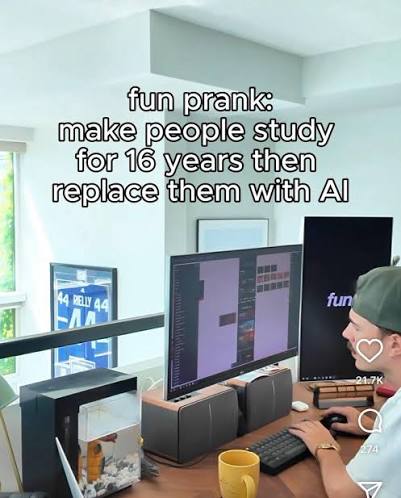
The major reason why people believe in science is because it makes them have more money.

Consider: Most people who go to school (or study at university) do so because they think they will have a better job later in their life because of it.

People go to school (which is a big investment, as it takes years of time and lots of money) mostly because they expect it to pay off for them at some point. If that reason ceases to exist, lots of people would be demotivated to go to school. That's actually happening with AI rn: people feeling that it will be more difficult to find better jobs because of a college graduation will simply stop going to college. That means people say "college doesn't pay off". It's literally this meme:

[–] zz31da@piefed.social 2 points 2 days ago (1 children)

So then does trust == faith?

Of course it's not possible to understand absolutely everything, even as a well-informed scientist or academic. You say 'blindly trusting', but may be that's quite the right way to put it, since, presumably, you have determined that those experts know better than you do, i.e. it's not 'blind' in some sense. Whereas a religious person may blindly have faith that there is a God and a higher purpose (or whatever).

That said, to counter my own point, I'm sure there are plenty of religious people who determine that their religious leaders or experts are worthy of trusting because of a perceived higher spiritual connection, social status, or similar.

I think it all comes back to being able to think critically. In my mind at least, the word 'trust' implies some sort of rational thought process, whereas 'faith' has a bit more of an emotional connotation. But in reality it's probably more of a heavily-overlapping Venn diagram (assuming there's a distinction at all).

[–] squaresinger@lemmy.world 1 points 3 hours ago

Trust and faith are two extremely similar terms. So close that in some languages they are the same word (e.g. in German the word for religious faith, "Gottvertrauen" literally translates to "trust in God").

Tbh, most religious people have a more solid base to trust in some religious leaders than most people have for trusting in scientific experts. Compared to the experts, they at least know who the religious leaders are and have heard them talk.

I don't know who came up with the latest discoveries any scientific field, nor have I ever heard them speak, but I have faith that if I e.g. go to my doctor they will base my therapy and medication on a good scientific basis, even though I have no proof of that and no ability to verify anything they prescribe me. That's just as much blind trust as anyone who has seen a handful people getting better after some prayer sessions and thus trusts in their church for healing.

So in the end, I don't even know the identities of those experts I put my trust in. I know nothing about their skills, qualifications, abilities or even their research, and still I place my life in their hands every day, trusting that the food/vehicle/builting/medicine/... safety standards they came up with are keeping me safe. Trusting that they know what they are doing, even though we live in a world where Contagan, Boeing, Tesla, Exxon, Lehman Brothers, Meta and consorts exist and operate.

[–] Realspecialguy@lemmy.world 0 points 2 days ago

I think what you want to say is '"belief" is part of the scientific process"

Belief is essential. I believe 2 + 2 =4, I also believe that we are 1 solar system out of trillions.

Belief is quite simple and