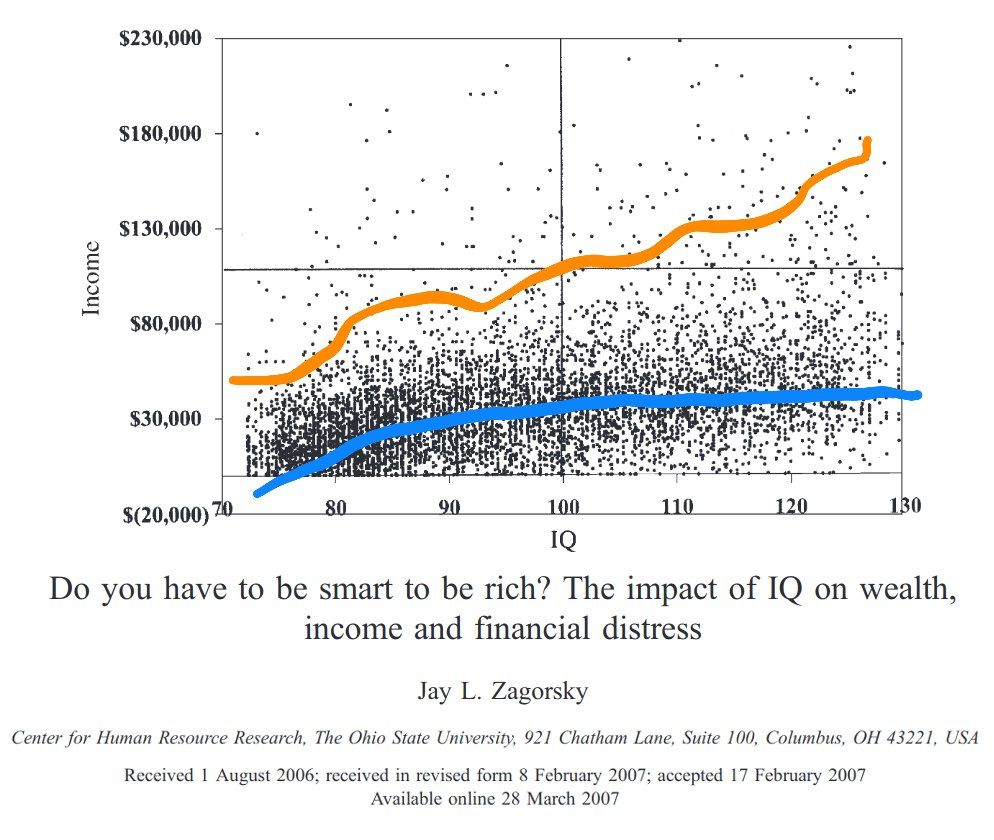
No test measures intelligence. A test only measures you relative to the persons that wrote the test. – loosely quoting Asimov.

2007 is ancient history now. It is an interesting graph that one might correlate with a lack of meritocratic structure in society, but I'm on the low end cause I say this without looking up and reading the study. Pretty pictures evoke emotional blabbering bias and all that.

I Quit
you are viewing a single comment's thread
view the rest of the comments
[–] 89 points 1 year ago (10 children)

Looks like there's some other Factor X (in orange) not accounted for in the data.

Y'know, like, rich parents, stable household, access to resources, and opportunities, etc

  • source
  • hideshow 10 child comments
  • [–] 70 points 1 year ago (6 children)

    Reminds me of the marshmallow test:

    But the marshmallow test is a tricky one. Replication studies reveal impor­tant details that are missing from Mischel’s triumphant analysis. On average, the kids who “fail” and eat the marshmallow rather than waiting and doubling their haul were poorer, while the “patient” kids were from wealthier back­grounds. When the “impatient” kids were asked about the thought process that led to their decision to eat the marshmallow rather than holding out for two, they revealed a great deal of future-looking thought.

    The adults in these kids’ lives had broken their promises many times: Their parents would promise material comforts, from toys to treats, that they were ultimately unable to provide due to economic hardship. Teachers and other authority figures would routinely lie to these kids, out of some mix of overly optimistic projection about the resources they’d be given to help the kids in their care, or the knowledge that the kids’ poor, time-strapped, frantic parents wouldn’t be able to retaliate against them for lying.

    So the kids had carefully observed the world they operated in and con­cluded, on balance of probability, that eating the marshmallow was the safe bet. At the very least, it foreclosed on the possibility that the adults running the experiment would come back in 15 minutes and declare that, due to circumstances beyond their control, they were taking back the original marshmallow, rather than providing two of them. They were thinking about the future, in other words.

    These kids didn’t grow up to do worse in school and life because they lacked self-control: Those outcomes were dictated by America’s two-tier education system, which funds schools based on local property taxes, topped up by parental donations, which means that poor neighborhoods get poor schools. If these kids’ brains show up differently on a scan 20 years later, Occam’s Razor dictates that this is caused by a life of desperation and precarity, whose stresses are compounded by inadequate health-care.

    https://locusmag.com/feature/cory-doctorow-marshmallow-longtermism/

  • source
  • parent
  • hideshow 6 child comments
  • [–] 10 points 1 year ago (4 children)

    Replication studies reveal impor­tant details

    Doesn't provide a source

  • source
  • parent
  • hideshow 4 child comments
  • [–] 7 points 1 year ago (2 children)

    He usually has a companion piece on his blog for anything that goes into Locus. There, he linked to the wiki page about the marshmallow test, which has a section on follow-up studies: https://en.wikipedia.org/wiki/Stanford_marshmallow_experiment#Follow-up_studies

  • source
  • parent
  • hideshow 2 child comments
  • Very interesting. I imagine an even simpler explanation for why poorer kids do less well in school:

    You simply can't focus on abstract thoughts if you're lacking basic ingredients in your life.

    It's something like the pyramid of needs:

    When you're hungry in school because you didn't have proper breakfast because your parents had too little time to prepare one or were unable to actually buy proper-quality ingredients, your brain simply can't focus on geography of the other end of the world or god forbid, calculus.

    I guess that if schoolkids were given free meals before school and during midday break, their performance in school-related activity would improve by at least 50% in poorer regions.

  • source
  • parent
  • [–] 1 point 1 year ago

    Not only that, on the other end of the graph it is known that poverty is a great stressor requiring constant mental bandwidth - that therefore can’t see used to “be smart”. So poorer people are not less smart, they allocated their mental resources to take care of their situation first and only later try to look smart in the test.

  • source
  • parent