93k may seem a lot, but I'm on holiday in EU right now and the closest hotspot is 40 minutes away. Still impressive initiative, I hope it gets more coverage.
post
93k access points run by a government that wants to read all our chats?

Vpns are cheap if that's an issue
just like border-free travel
Is this new? If they write this despite recent border checks the analogy has not the intended meaning.
Vpns don't hide mac addresses from phones that pass the access points.
Vpns don’t hide mac addresses from phones that pass the access points.
Pretty much every phone can use random MAC addresses, so you can't be tracked that way. Obviously there's a ton of other ways to achieve that, like via that app.
That tracking is done in a much more effective and capillary way by tracking cell towers. I think MAC tracking is a much better option, assuming there are enough of these APs to track.
It's amost like the EU isn't a monolith and has various groups opposing each other.
Can they actually if the chats run via HTTPS? Isn’t the whole point that they can’t read any data that’s going through but instead only what server it’s going through? As long as it goes over an encrypted connection, but I think all of our chats use encrypted connection nowadays
Not available on F-Droid. 🤔
Not only are they monitoring everything you view in their network, but you have to install their app on your device.
Good to see Exodus giving it a pass, but if it's not open source it's still something to be wary of. I literally can't think of any good reason for the app to be required, a splash page that you log in to is more than sufficient.
On connecting to the free Wi-Fi network for the first time, you will be redirected to a secure login page (a captive portal). You will be able to sign in with a simple click-to-connect functionality.
The app is just a map to see the hotspots, you don't need it to connect to them.
You're right, I was just going on the post saying "With the WiFi4EU app, you can access...", implying that you need the app to access it. But on their webpage it spells it out more clearly:
On connecting to the free Wi-Fi network for the first time, you will be redirected to a secure login page (a captive portal). You will be able to sign in with a simple click-to-connect functionality.
https://wifi4eu.ec.europa.eu/ currently says "The budget of the WiFi4EU initiative is EUR 120 million between 2018 and 2020" and "we propose today to equip every European village and every city with free wireless internet access around the main centres of public life by 2020"
It's unclear if this project is still being supported and/or expanding, but from the fact that the front page of the website apparently hasn't been updated in over five years I would guess not. Looking at a few major cities on their map it doesn't look like they came anywhere near covering the "main centres of public life" in any of them 😢
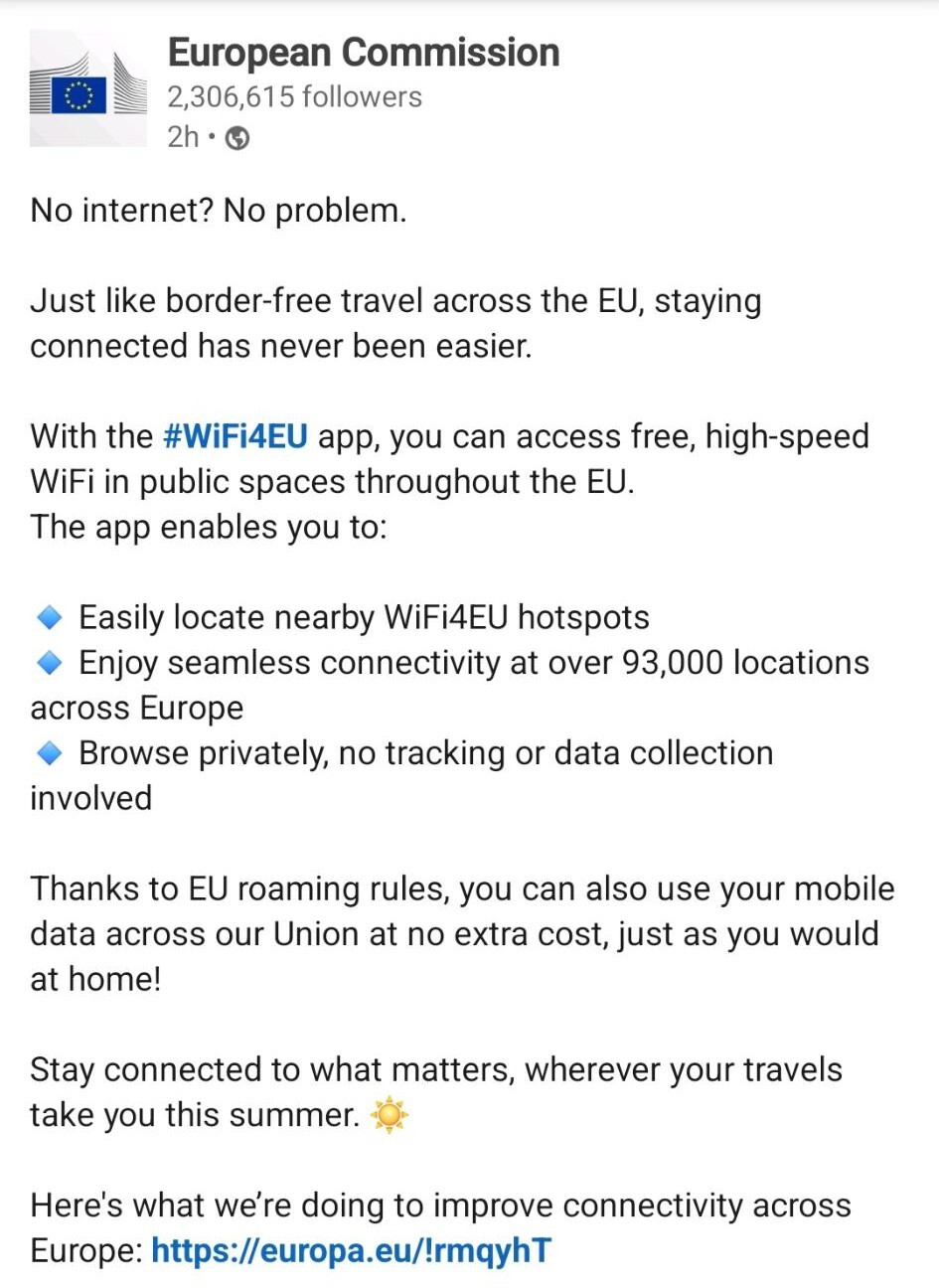
The reason I posted this was becuase they posted about it themselves on LinkedIn recently, so I am assuming its still a WIP project. https://www.linkedin.com/posts/european-commission_wifi4eu-activity-7359136374895046656-oXYi
It's almost like going back in time where there was a Fonera hotspot everywhere.
Anyone happens to know if this would be secure? I mean, I've heard of being wary connecting to public WiFi. What guarantees someone won't connect to a WiFi4EU network belonging to Shady McHoodie in the corner of a coffee shop instead of an official network? Do usual security / privacy recommendations apply? Would a VPN be recommended for said network? (I presume VPNs are good for public WiFi. Not sure if that is indeed the case).
Tricky thing is, you may think you're connecting to a legit network, but anyone can set their network name to a legit-sounding one. Mr. McHoodie could have a WiFi4EU, a Free-Airport-WiFi, a GFOTYBUCKS-WiFi. I assume at least once connected, your device won't be fooled into auto-connecting to a similarly named network
It's not really a concern anymore, now that pretty much all a lambda user's traffic is encrypted. Anyone collecting your wifi traffic only sees garbage.
Websites also can't be so easily spoofed. The spoofer would need to have a certificate issued by an authority trusted by your device for the spoofed domain, which is highly, highly unlikely to happen as long as your software is up to date, which nowadays is done automatically.
So really, the fear of untrusted public wifi is a thing of the past, and a good marketing lie for VPN companies.
Well, that’s not necessarily true, or else https://mullvad.net/en/blog/introducing-defense-against-ai-guided-traffic-analysis-daita wouldn’t need to be a thing.
I’m not worried about a website watching me as much as a government agency that wants information to use later.
Sure, your traffic itself is encrypted, but your browsing patterns aren’t and it would be wise to think that pretty much any network you connect to, even your home one could be being observed by some party and logged.
IMO it’s beneficial to use a VPN 24/7 on any connection. Mullvad costs 5 euros a month for and honestly I get better speed connecting to their Self hosted Sweden server from the US for most of my internet traffic since my ISP can’t QoS it
Privacy and security are two different things. A public WiFi is safe, I never said it is private. I actually said a VPN helps with the privacy issues in my following replies.
Edit: After re-reading the comment you replied to, I do see that I didn't specify if I am talking about privacy or security, that is my fault. I was talking about security.
Local municipalities applied for a voucher worth €15,000, which covers the costs of installation of a Wi-Fi hotspot in the town, functioning for a minimum period of three years. All local residents and visitors of the successful municipalities are now able to access the internet freely.
In America, this means that they would work for 3 years, and then some would start breaking until smaller local governments got more federal money for maintenance. Does Europe operate differently?
did a quick scan of their builtin permissions and trackers and looks good too
On startup, the app offers a choice of using it with or without geolocation.
I don't particularly like giving the permission, but it is made to help you find WiFi spots. That's easier if it knows where you are in relation to the spots, so there's a legitimate reason to ask for permission.
That doesn't mean they can be trusted with it necessarily, though. I dunno if they can or can't, just saying that having a legit reason to ask doesn't necessarily equate to trustworthy.
Interestingly, Paris, the first tourist destination in Europe, doesn't have any of those.
I think the city provides a good number of free hotspots disseminated about the place, but I never really looked into it. Hopefully they're both safe and convenient, but it's always hard to tell with those things, especially regarding the safe part.
Interestingly, Paris, the first tourist destination in Europe, doesn’t have any of those.
The wifi4eu map shows a dozen APs inside the Boulevard Périphérique:

but...
closer...

they're all in and around a single building 😂

top 50 comments