It opens my programs menu (or start menu to use the Windows vernacular). It's still incredibly useful for me to have it that way
this post was submitted on 13 Nov 2025
68 points (92.5% liked)
Linux
60009 readers
263 users here now
From Wikipedia, the free encyclopedia
Linux is a family of open source Unix-like operating systems based on the Linux kernel, an operating system kernel first released on September 17, 1991 by Linus Torvalds. Linux is typically packaged in a Linux distribution (or distro for short).
Distributions include the Linux kernel and supporting system software and libraries, many of which are provided by the GNU Project. Many Linux distributions use the word "Linux" in their name, but the Free Software Foundation uses the name GNU/Linux to emphasize the importance of GNU software, causing some controversy.
Rules
- Posts must be relevant to operating systems running the Linux kernel. GNU/Linux or otherwise.
- No misinformation
- No NSFW content
- No hate speech, bigotry, etc
Related Communities
Community icon by Alpár-Etele Méder, licensed under CC BY 3.0
founded 6 years ago
MODERATORS
The "Windows" key is just called "Meta" (Edit: or more commonly "Super") key in Linux. It's used for hotkeys, especially stuff that has to do with window management. I also set a simple press on it without other keys, which would open up "krunner" (to search or run apps).
KDE mostly calls it Meta, GNOME calls it "Super".
Right, I completely forgot about "Super". It might even be the more common term.
AFAIK, only KDE calls it Meta, everything else tends to use Super.
load more comments
(2 replies)
It's for window management related hotkeys. Obviously. All about windows. With a lowercase "w".
To open the App Menu, and for a mod key, same as in Windows
It's my Super key. It's used for like everything in my DE (Hyprland).
The default for Gnome. It's a really useful app switcher.
Came here to say this. Basically, the same way it's used in Windows. I hit the key, type a few characters and I launch the app I seek.
Exactly. I love Gnome for this.
It opens up anyrun.
I don't have one. If I did, I want change the keycap.
Now... it's called a meta key https://en.wikipedia.org/wiki/Meta_key ... and I use it exactly as one would on Windows, e.g. Meta-e starts the file explorer ... but I added my shortcuts too e.g. :
- meta+k for konsole
- meta+f for FIP (online French radio, music only, no ads)
- meta+F to stop FIP
- meta+a to play the series I'm currently watching
- meta+A to stop mpv (playing the current series)
- meta+o to turn on my office lights
- meta+l to turn off those lights
- meta+ESC to turn off lights and suspend computer
- meta+s for Spectacle to take a screenshot
and I have quite a others I can't recall right now.
Its the super key, the meta key is now Alt IIRC
Not according to Wikipedia (linked to initially already) nor KDE Plasma which I'm using :
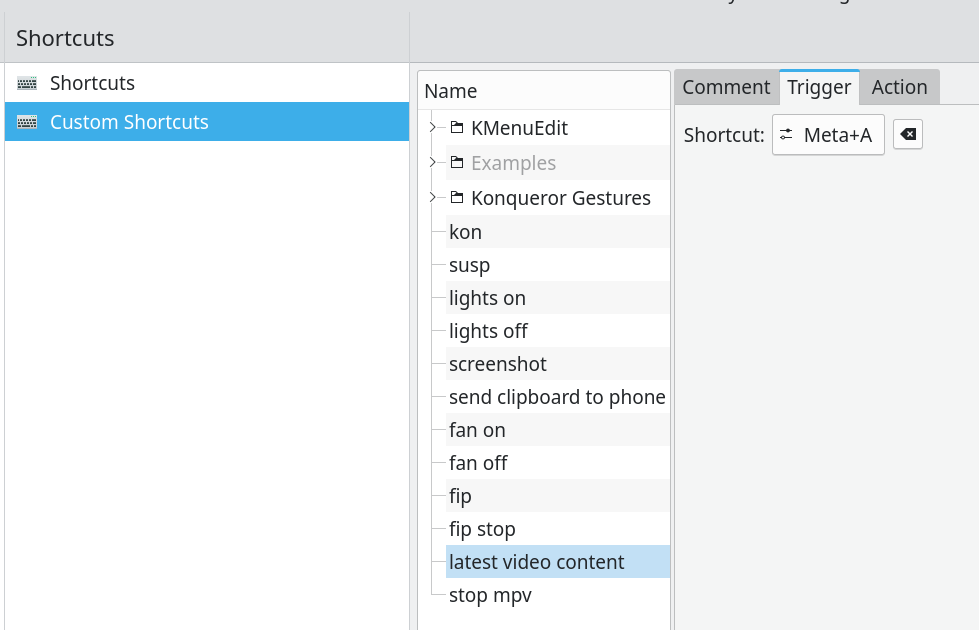
The wikipedia page you linked says otherwise.
On keyboards that lack a physical Meta key, its functionality may be invoked by other keys such as the Windows key or Macintosh's Option key.[4] However, software often provides another workaround, such as using the Alt key (which does not exist on the Knight keyboard), or using the Esc key as a prefix (e.g., in Emacs). Because of these workarounds, the need for Meta – despite being the most-used additional modifier key – was less than for other modifier keys. It is more common today to use the Windows key to emulate the Super key.
I don't have a physical keyboard with a Windows key to verify (gave that to a friend who need an ergonomic keyboard few weeks ago) but AFAICT xev or KDE Plasma again return meta when pressed on that key.
Also ZMK https://zmk.dev/docs/keymaps/list-of-keycodes list GUI as Meta GUI (Windows / Command / Meta) and QMK LGUI(kc) G(kc), LCMD(kc), LWIN(kc) https://docs.qmk.fm/feature_advanced_keycodes
My interpretation of "Meta key, its functionality may be invoked by other keys such as the Windows key or Macintosh’s Option key" is that the Windows key is the meta key, isn't it what it says?
KDE uses "meta" to refer to the Windows key. Emacs uses "meta" to refer to the Alt key. You are correct that GNOME calls the Windows key "Super".
This causes some confusion, obviously we Linux users don't want to call it the Windows key, so the best solution is to call the keys "Super" and "Alt", those are unambiguous.
load more comments
(2 replies)
As far as I am aware, the "Windows" key is generally mapped as the Super key, not he Meta key.
load more comments
(6 replies)
load more comments
(1 replies)
No differently than it's used in Windows, plus a few more key-chords that utilize it. That's the default in GNOME and KDE at least, and probably other DEs as well.
I'm more interested in what people do with that strange menu key sitting next to my touch-starved right-CTRL. I know it's for pulling up the context menu, but I have literally never used it for any reason. When I'm 100% keyboard, I'm probably in a terminal and it won't do anything any way.
The menu key is a convenient place to put the compose key.
load more comments
(1 replies)
a bunch of shortcuts
- mod + w for waterfox
- mod + n for thunar
- mod + q to quit a program
- mod + d for dmenu
- mod + f to force fullscreen
- mod + enter for a terminal
- hold it down to grab a window
etc.
Familiar, I see you are a person of tiling-culture as well.
load more comments
(1 replies)
I use it as a modifier key for all of the shortcuts I create since nothing uses it by default.
I don't have one. In its place I have a meta key with a diamond design on the keycap. Why would I need a "Windows" key if I haven't used Windows in over a decade?
load more comments
(1 replies)
I map it to the panel menu that most DEs still include. Unless you're Gnome, in which case you may as well use a joy stick to navigate that GUI.
As yet another modifier key. I use XFCE, so if I bind it to the applications menu, the applications menu will also pop up every time I use any other keybinding involving the Super key, which is less than ideal.
I don't know how controversial this would be, I wouldn't mind making it like the command key in MacOS either.
Super key for DE keybinds or other global hotkeys. Nothing uses it so you don’t have to worry about collisions.
meta and ctrl switched, because if there’s something apple did right it’s using the thumb as modifier key for copy/paste/etc instead of pinkie finger which is far FAR less able to deal with repeat strain
but i also type programmers dvorak because i got pretty horrible wrist pain at one point so anything to stop me damaging my wrists :p
Same as I do on Windows. When I want to open an application I press it and type in the name. For example: Windows, C, M, D, Enter (I type CMD even on Linux).
modifier for window manager nav and general OS controls like wofi/rofi
It does nothing and has been broken for a long time. It can be used for hotkeys but there are none that I use. I only want it to open the start menu. Yes i know I can easily bind it in KDE plasma hotkey menu but i havent gotten around to it yet.
i use it to open my apps menu, same as it did in windows, as well as a modifier key for desktop-level stuff... same as it did in windows lol
tho, i added one shortcut with it which i think is just neat: meta+Z to go to sleep. it's funny, memorable, easy to access yet hard to press accidentally. tbh i think it should become standard
I use it as the prefix key for my tiling window manager (stumpwm), and have mapped it to the "Super" X11 modifier for Emacs.
(Also, I have mapped CapsLock to the Hyper modifier, which I mostly use for user-defined commands. Not as powerful as the original space cadet keyboard, but not bad!).
BTW, one thing that is great about StumpWM is that you can define commands to script actions on GUI applications. For Example, if you are in a Firefox window, you can script Ctrl-t-B (or perhaps Hyper-B) to go to the adress bar, copy the URL, then call xsel to append the content of the buffer to a file which is called ~/bookmarks.txt, and finally open your preferred editor to add a comment.
Just general command key for shortcuts?
It is probably my most pressed button because of this, also i changed the keycap to eye of horus.
Switched the cap so I wouldn't have to see that ugly logo… mapped it to the super key for Hyprland
I did the same on my desktop. I haven't bought a laptop in forever though and idk what to do about them all having an AI key now.
load more comments
(1 replies)
I used to have bunch of key maps, now it's just: tap it to pull up the start menu and type software I want to open, and meta + space to change language input on my keyboard.
I guess pretty much it.
Bazzite KDE default seems fine for me.
I always just remapped it to the super button, and most applications actually automatically map it to the super button.
Left button for global shortcuts, right button for Compose
Change mine to blank transparent keycap, I generally use it for mod key
I have lots of shortcuts bound to it except I never press it because I have the caps lock key mapped to the same keycode and that's easier to press
I use my context menu key as the chording key to control any keyboard macro profiles, so that I can terminate, reload, summon for editing or summon a help file as needed.
One-handed locking my PC as I leave my desk with Windows-L.
view more: next ›