1


By Vijay Prashad  –  Oct 8, 2026

The U.S. wants to reorganise the mineral wealth of the Western Hemisphere around its own industrial and military needs while keeping China at arm’s length.

The map of the new war over minerals stretches from the lithium flats of South America to the rare-earth deposits of Greenland. Its vocabulary is familiar: supply-chain resilience, national security, diversification and partnership.

Beneath these neutral phrases lies an older project.

The United States wants to reorganize the mineral wealth of the Western Hemisphere around its own industrial and military needs while keeping China at arm’s length. The latest name for this ambition is President Donald Trump’s Corollary to the Monroe Doctrine of 1823 — crudely nicknamed the “Donroe Doctrine.” The joke is crude, but the politics are not.

Critical minerals are not inherently critical. Copper, lithium, graphite, cobalt, nickel and rare earths become critical within a particular system of production that increasingly requires electrical grids, batteries, data centers, semiconductors, satellites and fighter aircraft.

The International Energy Agency expects demand for these minerals to almost double by 2040 under stated policies, with lithium demand more than tripling. The decisive bottleneck is not geology but the command of metallurgy, patents, finance, separating, refining and markets. China refines more than 90 percent of global gallium, graphite, manganese and several key categories of rare earths. This is the industrial fact that Washington’s security documents translate into the language of “threat.”

Marjorie Arnfield, England, Breaking the Coal, c. 1920. (Via Tricontinental Institute)

In April 2025, the White House ordered a Section 232 investigation into processed critical minerals and their derivative products, treating import dependence as a possible threat to national security.

In January 2026, after the investigation concluded that such imports did threaten US security, Trump directed negotiations with trading partners and proposed price floors and other trade restrictions.

In July, he invoked the Defense Production Act for the recovery of critical minerals from scrap and used goods. Taken together, these measures by the United States government describe a belligerent industrial policy that is backed by tariffs and military threats.

US critical minerals policy is designed not only to seek mines abroad but also to enforce political authority over where these minerals may be sold, whose technology may process them and which banks may finance the chain.

The 2025 Trump executive order on seabed minerals stated its objective with unusual clarity: the United States will strengthen “partnerships with allies and industry to counter China’s growing influence over seabed mineral resources.”

The Trump Corollary extends that logic across the hemisphere, treating Latin America and the Caribbean not as a region of sovereign development projects but as the near abroad of the United States: a protected reservoir of agricultural commodities, metals, minerals, ports and sea-lanes.

In his monumental book Open Veins of Latin America (1971), Eduardo Galeano wrote of the “mortality of wealth” — how the region’s natural abundance brought sorrow to its peoples. This ugly contradiction between wealth and exploitation continues.

Aage Gitz-Johansen, Denmark, Eskimoen dør / The Eskimo Dies, 1958. (Via Tricontinental Institute)

Greenland reveals the Trump Corollary in its most naked form. Far from an empty white space as it is often portrayed, this Inuit society of roughly 57,000 people has a long history of Danish colonial rule and an unfinished struggle for self-determination. Its position between North America and Europe, the US military base at Pituffik, the opening Arctic sea routes and deposits that include rare-earth minerals have made it an object of renewed attention.

Trump’s repeated desire to acquire Greenland reduces the Inuit people’s homeland to real estate and military strategy. Trump claims that he has now taken Greenland from Denmark, but the details of the security agreement are far more ambiguous than his social media posts.

The pressure on Greenland and on Latin America is part of the same imperial imagination. The US sees the former as its northern shield and the latter as its southern storehouse.

In both, the stated aim is to prevent Chinese capital, infrastructure and technology from gaining a durable position. Yet what is at stake is not the freedom of Chinese investment but the sovereignty of countries to chart their own independent foreign and economic policy. The issue is that Washington claims the authority to decide which relationships are permissible. The promise of sovereignty becomes conditional on alignment with US imperial ambitions.

Rosemary Namuli Karuga, Kenya, Three Women Walking, 2001. (Via Tricontinental Institute)

Latin America has lived through this story. Galeano’s book details the journey of silver from Bolivia, guano from Peru, nitrates from Chile, copper from Chile and Peru, iron ore from Brazil and oil from Venezuela to successive centers of capitalist accumulation.

The commodity changes from country to country but the structure endures: extraction at the periphery, technology and finance elsewhere and socialized damage at the pithead. The so-called green transition can repaint this structure without overturning it.

Venezuela in a Time of Geopolitical Climate Change

The figures reveal both the opportunity and the danger. The International Energy Agency reports that, excluding lithium, Latin American countries refined on average only 20 percent of the key energy minerals they extracted in 2025. Under the existing project pipeline, the region could capture about $185 billion in economic value by 2035, but only one-fifth would come from refining. Greater local refining could raise that value to roughly $220 billion.

The UN Conference on Trade and Development argues for a regional industrial policy with greater public investment in infrastructure and education, clear rules for locally sourced goods and labor (local-content rules) and technology transfer and control over the pace and terms of extraction. The question is whether these tools will serve public planning or merely subsidize foreign corporations.

Sebastiao Salgado, Brazil, Serra Pelada Gold Mine, Brazil, 1986. (Via Tricontinental Institute)

The epicenter of this debate is Brazil, which holds about 23 percent of known rare-earth reserves but produces roughly 1 percent of global output and lacks an integrated processing chain that runs from separation through metal and alloy production to permanent magnet manufacturing.

At the Pela Ema mine in Goiás, the Serra Verde Group produces a mixed rare-earth carbonate. The difficult and profitable stages take place abroad. Brazil keeps the excavation, some jobs and taxes and the environmental liabilities while higher-value production, patents and strategic control leave the country.

This is why the proposed acquisition of Serra Verde by US-backed USA Rare Earth matters. The deposit contains dysprosium and terbium, indispensable for high-performance magnets used in electric motors and military systems. US financing and purchase commitments turn the acquisition into more than a private transaction: it is part of a state-directed attempt to construct a supply chain that excludes China. Around the mine, rural and quilombola communities face polluted streams, threats to their land and mining claims that menace agrarian-reform settlements. A mineral cannot be called “green” when its costs are transferred to the people who live above it.

Brazil’s answer cannot be a simple change of customer. Cooperation with China, the United States, or Europe should be judged by what knowledge and capacity remain in Brazil, not by the nationality of the buyer. Certain basic rules must apply:

  • Public control over geological information and strategic deposits.
  • Public finance through the Brazilian Development Bank (BNDES).
  • Public investigation of the ecological impact, including environmental licensing to examine cumulative watershed impacts.
  • Indigenous, quilombola and local agrarian communities must have enforceable rights to free, prior, and informed consultation.
  • Scrutiny of foreign takeovers of mines.
  • Technology transfer requirements written into contracts.
  • Research led by Brazilian universities and public research institutes.
  • Mandatory domestic separation and refining of the ore.
  • Regional cooperation to build scale in batteries, chemicals, machinery, magnets and recycling.

Tom McGuinness, Britain, Belt Fitters, 1963. (Via Tricontinental Institute)

The countries of the South must reject the false choice between serving a Chinese-centered chain and entering a US-controlled one. Social movements must fight for popular sovereignty, which would require that these arrangements be made with public companies, through public institutions, with transparent mandates, common environmental standards, and shared research. The extraction of metals and minerals must be planned for socially necessary uses and not by the dictates of luxury consumption and permanent war.

The deepest vulnerability exposed by the mineral contest is not dependence on one country. It is the subordination of life to supply chains governed elsewhere.

The Trump Corollary promises to secure the hemisphere and its wealth for the United States. A people’s doctrine would secure natural resources for the benefit of those who live on the land, prioritizing electricity before exports, water before waste, knowledge before royalties, and sovereignty before alignment.

The wealth beneath the soil must become visible in schools, hospitals, research centers, laboratories, restored ecosystems, and dignified lives — a future that cannot be shipped away in sacks of concentrate.

Lena Hugo, South Africa, Miner I, 2008. (Via Tricontinental Institute)

In 1904, the Nicaraguan poet Rubén Darío wrote “A Roosevelt (To Roosevelt).” Addressed to US President Theodore Roosevelt, the poem is a powerful indictment of imperialismo yanqui (Yankee imperialism). The stanzas below allude to Victor Hugo’s 1872 “Le Message de Grant” (Grant’s Message), in which Hugo writes to US President Ulysses S. Grant that the US flag, “sown with stars,” is “obscured” with a “stain of mud” (tache de boue):

Los Estados Unidos son potentes y grandes.

Cuando ellos se estremecen hay un hondo temblor

que pasa por las vértebras enormes de los Andes.

Si clamáis, se oye como el rugir del león.

Ya Hugo a Grant le dijo: “Las estrellas son vuestras”.

(Apenas brilla, alzándose, el argentino sol

y la estrella chilena se levanta…) Sois ricos.

Juntáis al culto de Hércules el culto de Mammón;

y alumbrando el camino de la fácil conquista,

la Libertad levanta su antorcha en Nueva York.

The United States is powerful and great.

When it shudders, a deep tremor

runs through the enormous vertebrae of the Andes.

If you cry out, it sounds like a lion’s roar.

Hugo already told Grant: ‘The stars are yours’.

(The Argentine sun, now dawning, has hardly begun to shine,

and the Chilean star now rises…) You are rich.

You worship Hercules and Mammon alike;

and lighting the path of easy conquest,

Liberty raises her torch in New York.

(Consortium News)


From Orinoco Tribune via This RSS Feed.

2


By Steve Ellner  –  Sep 11, 2026

Donald Trump’s success in wresting concessions from Venezuela’s interim President Delcy Rodríguez is a clear demonstration of what can be achieved through the barrel of a gun. Just hours after the military incursion that resulted in the kidnapping of Venezuelan President Nicolás Maduro and First Lady Cilia Flores on January 3, Trump boasted, “We’re going to run the country,” and shortly thereafter called himself Venezuela’s “acting president.” He has also heaped praise on Rodríguez for serving both U.S. and Venezuelan interests, explaining “She’s doing a great job because she’s working with us.”

It’s not hard to understand why Rodríguez – whose father was a revolutionary martyr – has been so compliant. On January 3, just hours after the kidnapping of Maduro and Flores, Trump publicly threatened then vice-president Rodríguez and other Chavista leaders with what amounted to decapitation, along with a far larger military assault. According to Rodríguez, Rubio by phone gave her and the second-in-command Diosdado Cabello 15 minutes to acquiesce to Washington’s new terms or face death. As she put it, “the threats and the blackmail are constant.”

Some critics of the leftist government question the credibility of Rodríguez’s claim. Her version, however, makes perfect sense. Trump himself repeatedly made similar threats in public, though couched in more oblique language. And decapitation is exactly what Washington subsequently did to much of Iran’s leadership.

Washington’s toolkit of coercive measures against Rodríguez includes the use of blackmail. Reuters reported in March that federal prosecutors “put together possible corruption and money laundering charges, and have communicated to Rodríguez that she is at risk of prosecution unless she continues to comply with Trump’s demands.” The prosecutors’ money-laundering allegation in the Venezuelan oil industry is a code word for circumventing U.S.-imposed sanctions.

Trump touts the benefits the United States derives from the neocolonial relationship he has established with Venezuela. On August 28, he announced the reaching of “the biggest oil deal in world history” which gives the U.S. priority treatment for the sale of 65 billion barrels of proven reserves in their entirety, greater than those in the U.S. Other generous aspects of the deal include 20 percent of the oil production to be purchased at cost by the State Department and the Pentagon’s 35 percent ownership of the operating company.

The threat of military force is only part of the explanation for Rodríguez’s willingness to accept the deal. The devastating toll that a decade of severe U.S.-imposed sanctions has taken on Venezuela’s state-run basic industries such as oil, gas, electricity, and telecommunications has to be brought into the picture. The sanctions impaired the ability of the state oil company PDVSA to maintain, repair, replace and operate equipment, as has been recognized by the U.S. congress’ Congressional Research Service and nonpartisan research organizations.

In the latter years of his rule, Maduro acknowledged the deterioration and turned increasingly to private capital. Among those who benefited was Alejandro Betancourt who, unlike Venezuela’s traditional bourgeoisie, had developed close ties with the Chavista government. The new 65-billion-barrel deal under Rodríguez designates Betancourt as the key operator and in doing so recognizes that he is better positioned to attract vast sums of foreign capital than a highly deteriorated PDVSA. The system of sanctions intimidated everyone involved in Venezuela’s oil industry, forcing operations into secrecy and creating fertile ground for corruption. Betancourt himself was accused of illicit dealings. Despite these charges, Chavista leaders prefer dealing with businesspeople like Betancourt, rather than the traditional elite that spearheaded several attempts to topple Chávez. Most of the blame for the corruption rests with Washington.

For all Trump’s warm words about Rodríguez, the sanctions that have inflicted such damage on the Venezuelan economy remain in place. Trump has only selectively loosened them by issuing individual “licenses” in order to favor U.S. capital.

Navigating or selling out?
On several occasions, pressure and threats from Washington forced Rodríguez to swallow her nationalistic pride as a longtime leftist. One was Venezuela’s cooperation with the U.S. Southern Command in carrying out the air strike in June that killed Niño Guerrero, the top leader of the notorious gang Tren de Aragua. Compare that with Mexican president Claudia Sheinbaum’s repeated refusal to accept joint military operations on Mexican territory against drug cartels.

In addition, following Venezuela’s highly destructive dual earthquakes on June 24, Rodríguez met with an Israeli delegation that included military officers at the presidential palace and praised Israel’s role in the relief efforts. Chavista demonstrators protested the U.S. and Israeli military presence following the earthquake with the slogan “This Isn’t Aid, It’s Occupation.” President Chávez had broken relations with Israel in 2009.

The problem, of course, isn’t just foreign policy. The Rodríguez government has reformed Chávez’s flagship legislation the Organic Hydrocarbon Law (LOH), which had set off the abortive coup against him in April 2002. Rodríguez’s reform, which modified the LOH in fundamental ways, set the stage for Trump’s “biggest oil deal in history.”

In the early months of Rodríguez’s presidency, some on the left credited her ability to navigate such a precarious situation. Former Italian Red Brigades militant Geraldina Colotti called it “an act of political maturity in a context of unprecedented blackmail.” Now, however, her deference to Washington has divided the U.S. left, as it has in Venezuela.

Those who support the Rodríguez government run the risk of ultimately being viewed as lending support for an imperial project. Defending Trump’s “biggest oil deal in history” is particularly uncomfortable because leaders on the other side of the political spectrum are denouncing its lack of transparency. Amazingly, economist Ricardo Hausmann, one of the main architects of Venezuela’s neoliberal project of the 1990s, calls the deal “the most imperialistic thing the U.S. has ever done in its history.”

Particularly worrisome is the prospect that the Trump administration abruptly changes course and opts for regime change, before Rodríguez’s strategy for economic recovery gets off the ground. Such a shift from transactional pragmatism – it’s all about the oil – to rabid anti-communism is in line with the position championed by Marco Rubio and other right-wing hawks. The break with Rodríguez is predictable, though not the timing.

Thinking strategically
Progressive activists have to place Trump’s imposition of the notorious Monroe Doctrine – now the Donroe Doctrine – at the forefront of all solidarity work. The pro-Venezuela and pro-Cuba solidarity movements have shown that the most committed activists are those who to varying degrees sympathize with those governments not the ones who demonize them.

It’s easy to say that Rodríguez, her brother Jorge, Cabello and the other top Chavista leaders should simply say no to Trump and walk away rather than negotiate in such an unequal relationship. That’s what some on the left advocate. But is abandoning power or inviting military retaliation at this moment an option?

Juan Carlos Monedero, a former leader of Spain’s Podemos party and advisor to Chávez, told me: “The Chavista leadership under Delcy should consider abandoning power since the relationship with Washington is just too asymmetrical. The Sandinistas did that in 1990 and then returned.”

Relinquishing power, however, would mean turning it over to the extreme right led by María Corina Machado, who has many powerful supporters in Washington. If you go back to the 48 hours during the 2002 coup when the right-wing opposition unleashed repression against the Chavistas – with dozens killed – or if you examine Machado’s vindictive rhetoric over the years you will know what is in store for the Chavistas and the social movements if she reaches power: repression Pinochet style. In addition, her slogan “popular capitalism” – which she borrowed from Margaret Thatcher and Pinochet – underscores the extreme neoliberal policies that she embraces. The burden is on those on the left who demonize Rodríguez to explain what realistic strategy they advocate.

Moreover, a Machado government would add to the growing number of far-right, pro-Trump governments belonging to the “Shield of the Americas,” an alliance committed to militarization under the banner of combating drugs, but with the real aim of driving China from the region. At the founding summit of the Shield in Doral, Florida in March, Trump reportedly phoned Machado, put the call on speaker, and told her “Everybody loves you here.”

Chávez, Maduro and Rodríguez have drawn inspiration from the example of China. During one of her many official visits to China in 2025, Vice-President Rodríguez praised the Chinese economic model as “an example of dignity, resilience and economic growth.” A guiding principle of China’s foreign policy, dating from Mao’s death in 1976, was Deng Xiaoping’s dictum “hide your strength, bide your time.” The phrase basically means that when the correlation of forces is unfavorable, don’t antagonize or alarm your enemy. This is precisely what Rodríguez is doing. Objective conditions in Venezuela – the result of a veritable war waged from Washington – and subjective conditions – the resultant erosion of enthusiasm even among the Chavistas – are highly unfavorable. The strategy may invite criticism given the obvious differences between Communist China and capitalist Venezuela, but it is hardly far-fetched – and even less so counterrevolutionary.

Rodríguez’s pragmatic strategy is in line with the general mood of the country – cutting across the political spectrum. Venezuelans as a whole are exhausted from the devastating effects of Washington’s war on Venezuela which played a central role in driving the average workers’ income down by roughly 80% since the mid-2010s. The call by Machado’s followers grouped in the Vente Venezuela party for mass protests against Rodríguez has not materialized.

Why Pentagon is the Central Axis of the US-Venezuela Oil Deal

Agree to disagree
One searches history in vain for a close parallel to what is unfolding in Venezuela. Consider: an imperial power kidnaps a country’s president, then reaches agreements and establishes friendly relations with his vice-president who remains committed to the ideals of the movement they both represent. For Rodríguez, the uniqueness presents a formidable challenge.

The Left must also recognize that, more than is usually the case, crucial pieces of the puzzle remain unclear. Most important, nothing is known about the negotiations between the Rodríguez government and the Trump administration. Time reports that “Rubio and Rodríguez are in nearly daily contact through phone calls and WhatsApp messages,” but without revealing the details. The key question is just how far Rodríguez can go in defending Venezuelan interests without triggering a turnaround on the part of the all-too-erratic Trump. At what point will Trump go from his transactional, pragmatic mode to his anti-Communist mode and promote regime change in Venezuela?

Critics of the Rodríguez government are right to warn that alliances with sectors of the bourgeoisie, as represented by Alejandro Betancourt, could open a Pandora’s box which ends up corrupting the broader project of change. But drawing clear lines between friends and foes from within may have to wait for better times, when real options are on the table.

Meanwhile, the solidarity movement needs to remain united, even with diametrically opposed viewpoints on the Rodríguez government. The starting point has to be an acknowledgment of the uniqueness of the moment and of how much remains unknown. Most important, the movement needs to stay focused on combating the atrocities committed by Washington: the liberation of Maduro and Flores, the lifting of all sanctions and the return of billions of dollars of Venezuelan assets seized abroad at the behest of Washington. There should be no doubt that the blame for Venezuela’s dire situation both before and after January 3 lies squarely with Washington.

(Counterpunch)


From Orinoco Tribune via This RSS Feed.

3


Federal Police, Prefecture, and Gendarmerie forces repressed a protest outside Congress in Buenos Aires on Friday, injuring more than 1,500 people – including 20 press professionals – and detaining at least 18, during a rally against the ruling party’s Bill on the Inviolability of Private Property, which was subsequently stripped of its two most controversial chapters following widespread social, union, and political rejection.


Among the injured press workers, a photojournalist received a heavy baton blow to the head that caused a fracture to the base of her skull and damage to her left ear. She remains hospitalized under observation and neurological evaluation.

RELATED: Argentina Senate Passes Revised Property Rights Bill

The security operation began at approximately 16:30 local time and lasted for at least four hours. Tactics included the indiscriminate launching of chemical gases, tear gas canisters, and pressurized water from water cannon trucks, alongside rubber bullets, Byrna rounds, baton blows, and shield thrusts.

The Press Defense Office (DPM) characterized the march as one of the most violent and longest in time and distance seen in recent years due to police action.

In the aftermath, the executive branch of President Milei denounced the demonstrators and is threatening prison sentences of five, fifteen, or thirty years. The Ministry of Security, headed by Alejandra Monteoliva, has filed a criminal complaint.

The rejection of the bill led to the removal of the chapter on the foreignization of land as well as the reform to the Fire Law, which would have permitted the privatization – and effectively the sale – of forested lands affected by wildfires.

Sipreba Secretary-General Agustín Lecchi told the newspaper Perfil that the operation was designed to discourage the mobilization and prevent the events from being recorded. He asserted that the repression was “not naive” and aimed to ensure the square remained empty during the voting hours. Lecchi further stressed that the attack on the protest – and particularly on the press – was intended to prevent the visibility of the repression, adding that professional and critical journalism is a fundamental pillar of democracy and “bothers those who believe they are the owners of the truth.” He confirmed that the injured colleague is stable.

❌NO A LA REPRESIÓN A LA PRENSA Y A LA PROTESTA

Una vez más, el gobierno de Milei reprime a quienes se manifiestan. Una reportera fue herida en la cabeza y decenas de trabajadores de prensa gaseados.

Informar y protestar no es delito. Libertad a todos los detenidos.@aRGra_ pic.twitter.com/q6DGJO6f9n

— SiPreBA – Sindicato de Prensa de Buenos Aires (@sipreba) August 6, 2026


From teleSUR English via This RSS Feed.

4


(FILE) Evo Morales has emphatically rejected any accusation and maintains that it is a matter of political persecution. Photo: Pagina 12.

Bolivia’s Prosecutor’s Office in Santa Cruz issued an arrest warrant Wednesday against former President Evo Morales for his alleged role in the 53-day road blockades against the neoliberal policies of President Rodrigo Paz’s administration.


The former President, who governed Bolivia from 2006 to 2019, faces charges including armed uprising against state security, terrorism, attacks on transportation safety, criminal association, public incitement to commit crimes, and attacks on public service security. Juan Carlos Huarachi, former executive secretary of the Bolivian Workers’ Central (COB, in Spanish), was also charged.

The warrant marks the latest escalation in the government’s judicial offensive against Morales and allied social movement leaders.

RELATED: Evo Morales Denounces Service Cuts in Cochabamba

Morales has emphatically rejected the accusations, calling them politically motivated persecution. “This is not justice, this is persecution,” the former president stated from Cochabamba, where he remains under the protection of thousands of supporters. His defense team previously argued that a separate arrest warrant issued years ago in Tarija for alleged human trafficking charges had already expired under statutes of limitations.

The 53-day blockades emerged as the central expression of a mass popular uprising against President Paz’s neoliberal agenda, which social movements characterize as an attempt to dismantle the plurinational state model established under Evo Morales’ government. Protesters demanded dialogue and accused the right-wing administration of governing for traditional elites rather than the country’s marginalized majorities.

Hoy el gobierno emite una nueva orden de aprehensión en mi contra, acusándome de supuestos delitos de terrorismo y alzamiento armado. Buscan responsabilizarnos de las movilizaciones sociales para ocultar el verdadero drama que vive Bolivia: una profunda crisis económica y social,…

— Evo Morales Ayma (@evoespueblo) July 29, 2026

Text reads: “Today the government issued a new arrest warrant against me, accusing me of alleged crimes of terrorism and armed revolt. They seek to hold us responsible for social mobilizations in order to hide the real drama that Bolivia is experiencing: a deep economic and social crisis, the result of a model that has abandoned the people and protected corruption.

Our position has always been clear: we are on the side of those who suffer from adjustment, fuel shortages, rising cost of living, insecurity and the rise of drug trafficking. With processes and political persecution they will not solve the problems that they themselves have caused; they only try to divert attention with a new headline...”

Among the key demands raised during the mobilizations were the non-criminalization of social protest and the guarantee that protest leaders would not be apprehended -demands that the arrest warrant now directly contradicts.

For grassroots leaders, the detention orders against Morales and other popular figures represent a smoke screen to divert attention from the government’s own responsibility in the deepening crisis facing the Andean nation. “The Paz government refuses to recognize its role in creating this situation,” said local leaders in statements to the press, arguing that the administration has chosen judicial repression over political dialogue.

Historical Context and Implications

This is not the first arrest warrant issued against Morales. In previous years, authorities in the department of Tarija ordered his detention in a separate case that his defense claims has already prescribed. The pattern of judicial actions against the former president has drawn criticism from human rights organizations and international observers who warn of the weaponization of the judiciary for political purposes.

Morales, Bolivia’s first native president, led the country for nearly 14 years before being forced into exile following a disputed 2019 election and subsequent political crisis. He returned to Bolivia in 2020 and has remained an influential figure in national politics, leading the Movement Toward Socialism (MAS, in Spanish) party. Despite being barred from running for president again under constitutional term limits, his political influence remains significant, particularly among Indigenous and working-class constituencies.

The arrest warrant is likely to deepen the already severe political polarization in Bolivia. The MAS party has condemned the measure, calling it an unconstitutional attempt to silence opposition voices. Meanwhile, the Paz administration defends the judicial process as a necessary response to what it describes as acts of sedition that threatened public order and the rule of law.


From teleSUR English via This RSS Feed.

5


Mexico City, Mexico, December 11, 2025 (venezuelanalysis.com) – Venezuela accused the United States of committing “international piracy” after US authorities seized an oil tanker in the Caribbean, denouncing the action as part of a long-running US campaign to strip the country of its energy resources.

US President Donald Trump announced Wednesday that Washington seized an oil tanker sanctioned by the US off Venezuela’s coast. He described the vessel as the largest oil tanker ever seized and indicated that the United States would retain the crude aboard.

The move was met with a sharp rebuke from Caracas.

“The Bolivarian Government will appeal to all existing international bodies to denounce this grave international crime and will defend its sovereignty with absolute determination,” read the communiqué. “Venezuela will not allow any foreign power to take from the Venezuelan people what belongs to them by historical and constitutional right.”

According to Reuters, the “Skipper” tanker loaded an estimated 1.8 million barrels of crude at Venezuela’s José terminal early this month before unloading 200,000 to a Cuba-bound ship. The remaining cargo was believed to be destined for Asian markets. The move was viewed as aggression against Cuba as well, which relies on Venezuelan oil shipments for energy and income.

Cuban Foreign Minister Bruno Rodríguez Parilla condemned “the vile act of piracy” as a violation of international law.

Michael Galant, member of the Progressive International Secretariat, said that calling the US seizure an act of piracy fell short.

“This is the deliberate immiseration of the Cuban people, already suffering debilitating fuel shortages, blackouts, and a chikungunya outbreak thanks to the US blockade,” wrote Galant on social media.

US Attorney General Pam Bondi posted a video on social media on Wednesday evening showing armed US forces boarding the vessel. There was reportedly no resistance from the crew nor any casualties. The assault involved Coast Guard members, Marines, and special forces who were seen in the video descending from helicopters onto the ship’s deck.

The seizure of the tanker comes only days after Delaware District Judge Leonard P. Stark approved the sale of Venezuela’s US-based refiner CITGO to Amber Energy, a process that Venezuela called a “barbaric theft” of a Venezuelan asset via a “fraudulent process.”

In past years, the United States has intercepted shipments of Iranian fuel bound for Venezuela, ultimately taking control of the gasoline and selling it at auction. While US-led sanctions have created significant challenges for the sale of Venezuelan oil on international markets, Wednesday’s seizure marks the first time the US has directly impeded a crude shipment of from Venezuela. Reuters reported that buyers in Asia were demanding further discounts on Venezuelan crude as a result of the seizure.

Trump’s latest move is a significant escalation in the latest US effort to oust the Nicolás Maduro government from power. Since September, the US has built up its forces in the region, including the mobilization of the Gerard Ford Carrier Fleet, and has carried out deadly strikes on boats that the administration claims are tied to drug trafficking.

Washington’s decision to seize the tanker drew scrutiny from US lawmakers who have questioned the true intentions behind military mobilization and campaign in the Caribbean.

“If Trump’s aggression in the Caribbean is about drugs, why did he just seize an oil tanker?” asked US Representative Nydia Velázquez. “This is yet another dangerous escalation that brings us closer to a regime change war.”

Senator Mark Warner, who serves as the top Democrat on the Senate intelligence committee, questioned how the US was able to seize an oil tanker but has opted to strike alleged drug smuggling boats from the skies without an effort to arrest the occupants or seize the purported contraband.

Democratic Senator Chris Van Hollen spoke Wednesday on the floor of Congress to call on lawmakers to stop Trump’s ”regime change war” against Venezuela.

Caracas maintains that the US attacks are motivated by a desire for regime change in order to secure access to Venezuela’s natural resources.

Venezuelan opposition leader María Corina Machado, speaking from Oslo where she traveled to receive her Nobel Peace Prize, publicly endorsed the seizure of the tanker as a “very necessary step.”

Juan González, Joe Biden’s former chief Latin America adviser and the architect behind the former president’s Venezuela policy, said that a US Naval blockade was “potentially a viable option” despite admitting that it would constitute an act of war against Venezuela.

The White House has repeatedly threatened further escalation, including land strikes. The New York Times reported that US officials expected additional seizures in the coming weeks. This action would constitute an act of force and place additional pressure against Venezuela’s oil industry.

The United Nations (UN) Charter expressly prohibits all Member States from using or threatening force against the territorial integrity or political independence of another state. Blockades imposed without a declaration of war or that are not sanctioned by the UN Security Council are not considered legal. Likewise, UN independent experts have consistently maintained that the extraterritorial application of unilateral sanctions is contrary to international law.

Edited by Ricardo Vaz in Caracas.

The post Venezuela Condemns US Tanker Seizure as ‘International Piracy’ as a Potential Oil Blockade Looms appeared first on Venezuelanalysis.


From Venezuelanalysis via This RSS Feed.

6
Venezuela, The Day After (mexicosolidarity.com)
submitted 10 months ago by [M, B] to c/latam@news.abolish.capital


This article by Luis Hernández Navarro originally appeared in the December 9, 2025 edition of La Jornada, Mexico’s premier left wing daily newspaper.

Since 2002, the date of the 47-hour coup against Hugo Chávez, Washington has unsuccessfully sponsored and supported regime change in Venezuela time and again. In the name of human rights, freedom, and democracy, economic sanctions, color revolutions, oil strikes, recognition of illegitimate leaders, theft of foreign currency and infrastructure, assassination attempts, media offensives, military uprisings, and threats of ground invasion have been instigated or combined without interruption.

Many of these attacks, aimed at seizing the largest oil reserves on the planet, are acts of international piracy. They have caused immense damage to the country and enormous suffering to its people. They have resulted in billions of dollars in lost oil revenue. Countless Venezuelans have been forced to migrate to other nations to survive. Meanwhile, a segment of the old, corrupt oligarchy lives the high life in their mansions in Miami and Madrid.

But despite the lethality of the punishments and the harshness of the siege, the Bolivarian Revolution continues. Certainly, some Chavista political leaders have betrayed the cause. A few military and intelligence officers have gone over to the enemy ranks. Intellectuals have succumbed to the siren song of metropolitan power. But, against all odds, the majority of the population draws a line in the sand against gunboat democracy; they remain loyal to a project that allowed them to recover their dignity and advance in popular power.

For 27 years, Bolivarianism has won almost every election. Desperate in the face of this setback, the empire has tried other formulas for regime change. In December 2007, Enrique Krauze laid his cards on the table. “If Hugo Chávez has thought of turning Venezuela into a Cuba with oil, the Venezuelans who oppose him have discovered the antidote. It is the student movement,” he wrote. So the far right latched onto this movement and tested an insurrectionary scheme. However, the reactionary forces clashed with a reality that wasn’t in their playbooks. So they left to make their fortunes abroad.

All imperial attempts at regime change have run up against what, until now, seems insurmountable: the unity of the Bolivarian National Armed Forces (FANB). There is not a single indicator showing any internal divisions. Part of the key to this unity is the development of a new military doctrine known as the Comprehensive Defense of the Nation. This doctrine seeks to confront the US military threat based on a set of actions designed to deter a technologically and numerically superior enemy.

This strategy has three central elements: strengthening military power, deepening the civil-military union (between the people and the soldiers), and bolstering popular participation in national defense tasks. Previously, the armed forces were fragmented into divisions and brigades. Commander Chávez organized the country into regions, and each region has a military structure with all its components: Army, Navy, Air Force, National Guard, militias, and the people.

If someone attacks a region, that region has the capacity to defend itself. It doesn’t need to move units from elsewhere. On February 23, 2019, under the pretext of bringing in humanitarian aid from Colombia, the Contras and Washington attempted to establish a beachhead in Táchira that would give the illegitimate Juan Guaidó control of a strip of Venezuelan territory to establish a “seat of government.” For 17 hours, fierce clashes erupted between Chavistas and Venezuelan paramilitaries and guarimberos, who operated mostly from the Colombian side. The skirmish ended with the opposition’s defeat.

Diosdado Cabello

There, amidst the events, at the military installation beside the Simón Bolívar Bridge, I spoke with Diosdado Cabello, then president of the National Constituent Assembly. Most of the FANB (National Bolivarian Armed Forces) chiefs were also present, whom he introduced to me as his friends and as longtime collaborators of Hugo Chávez. I asked him about the resolve of his troops. In good spirits, he explained: “President Maduro has visited every barracks. He shows up in the early morning.”

He arrives, runs with them, shares, does military exercises with them. We have total contact with them. We are like brothers. Many of us have been in this movement since we were children. We support each other and follow each other. We are a family. They will not break us…” Regarding the role of the militias, he told me: “For the friends of the State, they are a diamond. For the enemies of the State, they are the worst news.” A military intervention by a foreign country in Venezuela is very complicated, and not only because of the civil-military alliance.

Caracas has modernized its weaponry by acquiring it from Russia, China, and Iran, with whom it also maintains an alliance. Furthermore, it covers an area of ​​almost one million square kilometers. Its topography is highly diverse: the Andes mountain range, the Coastal Range, and the Guiana Shield, along with the extensive Orinoco River basin. It boasts 4,208 kilometers of coastline and dense rainforests. The poor neighborhoods of cities like Caracas are dangerous. It shares a 2,341-kilometer border with Colombia, a 2,199-kilometer border with Brazil, and a 789-kilometer border with Guyana.

No neighboring country desires armed conflict on its borders. Venezuela possesses the men, weapons, determination, and territory capable of sustaining a prolonged popular resistance, turning any attempt to occupy the country into a quagmire for whoever tries it. Regardless of what might happen on the day of the occupation, the true military challenge for an invading force lies in what to do in the days that follow. However, beyond what may happen in the future, in Venezuela, today is the time for peace.

Luis Hernández Navarro is the Opinion editor of La Jornada*, and the author of numerous books, including* Chiapas: La nueva lucha india and Self-Defense in Mexico: Indigenous Community Policing and the New Dirty Wars*.*

  • Venezuela, The Day After

    Analysis

    Venezuela, The Day After

    December 9, 2025

    Venezuela possesses the people, weapons, determination, and territory capable of sustaining a prolonged popular resistance, turning any attempt to occupy it into a quagmire for whoever tries.

  • People’s Mañanera December 8

    Mañanera

    People’s Mañanera December 8

    December 8, 2025

    President Sheinbaum’s daily press conference, with comments on the 4th Transformation anniversary, employment stats, new high schools, water law, US relationship, & 2026 World Cup.

  • Tren Maya on the Tracks of History

    Analysis | Interviews

    Tren Maya on the Tracks of History

    December 8, 2025December 8, 2025

    An interview with Étienne von Bertrab, author of the new book Más allá: una historia del Tren Maya.

The post Venezuela, The Day After appeared first on Mexico Solidarity Media.


From Mexico Solidarity Media via This RSS Feed.

7


Pitagorica survey shows shifting voter preferences ahead of January election. On Monday, polling firm Pitagorica released a voter intention survey showing that Luis Marques Mendes and Henrique Gouveia e Melo are currently the leading contenders for the presidency ahead of the Jaunuary 18 election. RELATED: Portugal Officially Recognizes the State of Palestine Former minister and […]

From teleSUR English via This RSS Feed.

8


It is more urgent than ever to understand and address the threat posed by transnational capital since the implementation of NAFTA in 1994. The USMCA, although it has a different name and some modifications, still represents a threat to our national sovereignty and the self-determination of our peoples.

The post Mexican Delegation in Washington to Fight USMCA Capitulation appeared first on Mexico Solidarity Media.


From Mexico Solidarity Media via This RSS Feed.

9
submitted 11 months ago by [M, B] to c/latam@news.abolish.capital


Environmental deregulation, rural abandonment, speculative pricing, and the prioritization of property rights over human rights were central tenets of neoliberal economic policy, whose impact on Mexican farmers is now a subject of reflection in our country.

The post The Crisis in the Mexican Countryside appeared first on Mexico Solidarity Media.


From Mexico Solidarity Media via This RSS Feed.

10


Caracas, Nov 17 (Prensa Latina) Venezuelan Foreign Minister Yvan Gil congratulated the Ecuadorian people on Sunday's referendum victory, which they are celebrating this Monday, and represents a major defeat for President Daniel Noboa.

The post Venezuela congrats Ecuadorians on referendum’s victory first appeared on Prensa Latina.


From Prensa Latina via This RSS Feed.

11


Caracas, November 17, 2025 (venezuelanalysis.com) – Delaware District Judge Leonard P. Stark dismissed efforts to challenge the ongoing auction of CITGO, clearing a major legal hurdle ahead of the forced sale of Venezuela’s most important foreign asset. Stark denied motions Thursday to disqualify himself, the court-appointed “Special Master” Robert B. Pincus, and the sale process...

The post Venezuela: Delaware Judge Dismisses Disqualifying Motions Ahead of CITGO Sale Ruling appeared first on Venezuelanalysis.


From Venezuelanalysis via This RSS Feed.

12


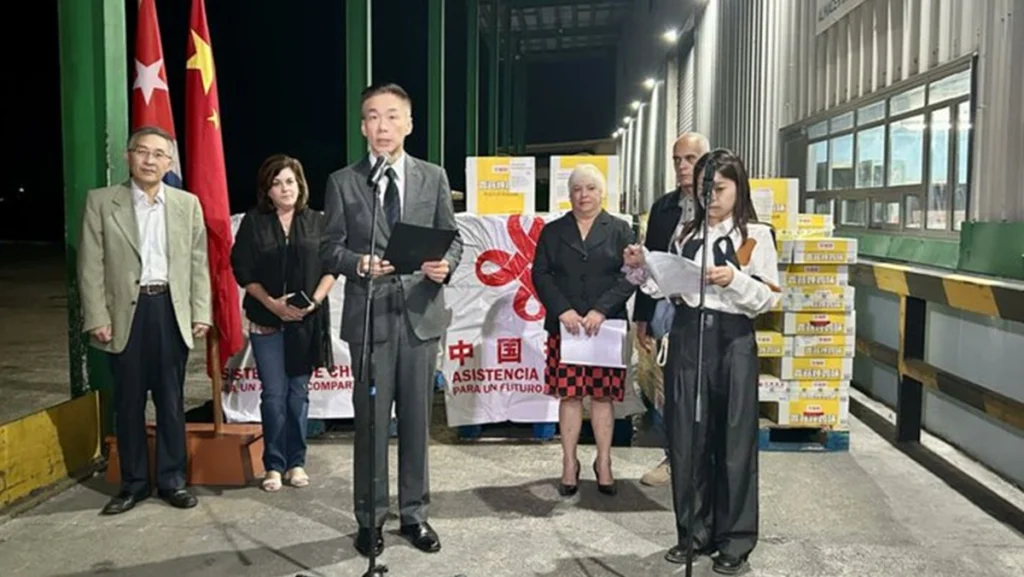
Venezuela, Colombia, Mexico, and the Dominican Republic have also sent humanitarian aid. On Sunday, nearly 30 tons of food and basic necessities arrived to Cuba on the first of six planned flights from China, as part of an emergency humanitarian aid shipment. Chinese Ambassador in Havana Huan Xi reaffirmed the commitment to bilateral cooperation after […]


From teleSUR English via This RSS Feed.

13


Moscow, Nov 17 (Prensa Latina) The Moscow State Institute of International Relations (MGIMO) and the TVBrics International Media Network signed an agreement aimed at expanding Russian education abroad, Prensa Latina informed.

The post MGIMO and TVBrics to promote education first appeared on Prensa Latina.


From Prensa Latina via This RSS Feed.

14


Phnom Penh, Nov 17 (Prensa Latina) More than 800 Cambodian families remain sheltered in a Buddhist pagoda in Banteay Meanchey province after being displaced from their homes following the latest incident on the border with Thailand.

The post More than 800 Cambodian families displaced by border incident first appeared on Prensa Latina.


From Prensa Latina via This RSS Feed.

15
submitted 11 months ago by [M, B] to c/latam@news.abolish.capital


Montevideo, Nov 17 (Prensa Latina) An attack against the headquarters of the National Institute of Rehabilitation (INR), the agency in charge of prison policy, has sparked widespread condemnation.

The post Uruguay condemns attack on prison first appeared on Prensa Latina.


From Prensa Latina via This RSS Feed.

16
submitted 11 months ago by [M, B] to c/latam@news.abolish.capital


Luanda, Nov 17 (Prensa Latina) Angola's National Assembly (parliament) will elect a new president today during the first ordinary plenary session of the fourth legislative term.

The post Angola to elect a new president first appeared on Prensa Latina.


From Prensa Latina via This RSS Feed.

17


San Jose, Nov 17 (Prensa Latina) Costa Rican railway authorities announced the resumption of normal service on San Jose-Heredia and San Jose-Alajuela train lines, following a collision with heavy equipment in the capital, reported Diario Extra.

The post Costa Rican railway back services after crash in the capital first appeared on Prensa Latina.


From Prensa Latina via This RSS Feed.

18


Belem, Brazil, Nov 17 (Prensa Latina) COP30 enters its decisive phase after six days of negotiations that have raised more questions than answers, in an atmosphere marked by demands from Amazonian indigenous peoples, civil society, and developing countries.

The post Ministers take control of a COP30 marked by little progress first appeared on Prensa Latina.


From Prensa Latina via This RSS Feed.

19


Addis Ababa, Nov 17 (Prensa Latina) Mobilizing political will, alliances, and resources are the objectives of the commemoration of the 5th African Union (AU) Awareness Week on Post-Conflict Reconstruction and Development.

The post UA seeks to mobilize political will in post-conflict reconstruction first appeared on Prensa Latina.


From Prensa Latina via This RSS Feed.

20


Tokyo, Nov 17 (Prensa Latina) Companies linked to tourism and retail in Japan reported a drop in their shares due to diplomatic tensions generated by the Japanese government with China, its main source of tourists.

The post Diplomatic tensions with China hit Japanese economy first appeared on Prensa Latina.


From Prensa Latina via This RSS Feed.

21
submitted 11 months ago by [M, B] to c/latam@news.abolish.capital


Cairo, Nov 17 (Prensa Latina) The Egyptian Red Crescent Society sent its 73rd convoy to the Gaza Strip with 9,300 tons of aid to paliate the humanitarian crisis facing Palestinians there, the organization announced.

The post Egypt sends new aid convoy to Gaza first appeared on Prensa Latina.


From Prensa Latina via This RSS Feed.

22
submitted 11 months ago by [M, B] to c/latam@news.abolish.capital


Brussels, Nov 17 (Prensa Latina) An Irish organization filed a complaint on Monday to the European Ombudsman against the European Commission (EC), accusing it of using ChatGPT to generate official responses, Euractiv reported.

The post EC accused of using AI in responses first appeared on Prensa Latina.


From Prensa Latina via This RSS Feed.

23


Christian Democratic youth rejects pension reform plan that guarantees benefits through 2031. During a forum organized by Süddeutsche Zeitung on Monday, German Chancellor Friedrich Merz said demographic change is working against preserving current levels of public pensions. RELATED: French Unions Press Lecornu Over Austerity and Pension Reform “We know that the level of public pensions […]


From teleSUR English via This RSS Feed.

24


More than 3 million people elected new grassroots committees. Between Nov. 8 and 9, Venezuela experienced an event unlikely to go unnoticed in the history of Latin American political organizations. During those two days, 145,465 neighborhood assemblies were held, with an average of 20 participants each. The result was that more than 3 million people […]


From teleSUR English via This RSS Feed.

25


U.S. Senators Graham and Blumenthal seek to impose tariffs on nations importing Russian energy products. On Monday, the Kremlin said it views as “very negative” a U.S. bill that would sanction countries doing business with Russia — an initiative backed by President Donald Trump. RELATED: Russia to Do Everything Possible to Preserve Strategic Stability “We […]


From teleSUR English via This RSS Feed.

view more: next ›