▲ 750 ▼ You'll be fine (europe.pub) submitted 11 months ago by Stamets@lemmy.dbzer0.com to c/rpgmemes@ttrpg.network 83 comments fedilink hide all child comments
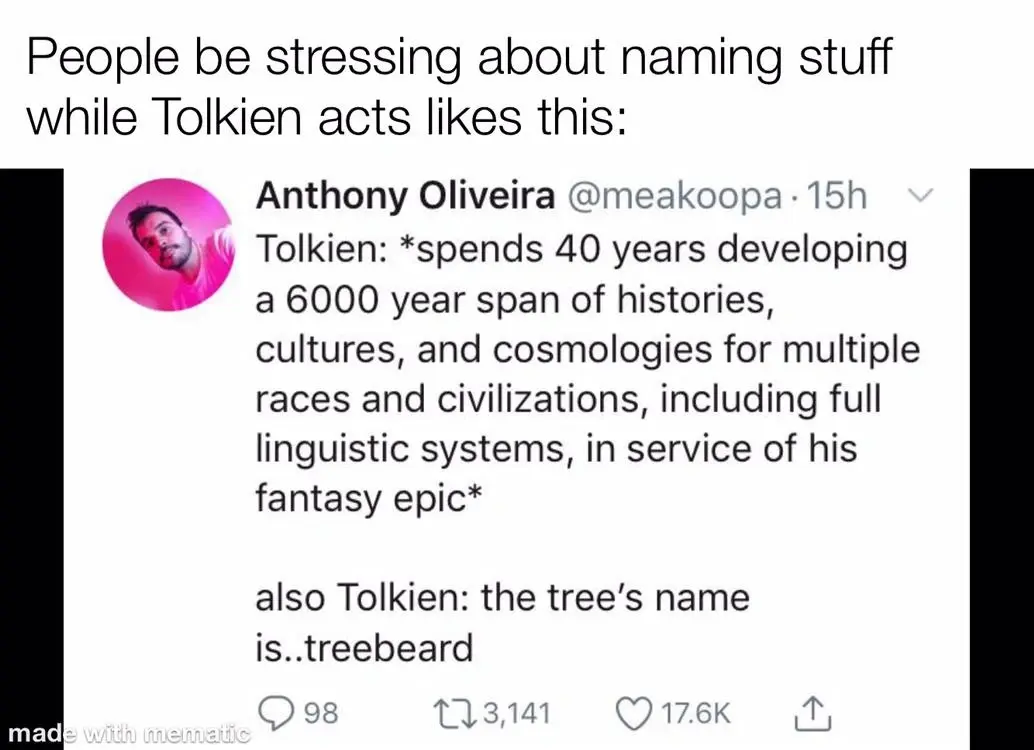
[–] DragonTypeWyvern@midwest.social 24 points 11 months ago (8 children) It keeps blowing my mind when I learn that other languages haven't obfuscated the meanings of names behind two thousand years of linguistic divergence. Your name almost certainly means something basic too, you just don't remember what it is. permalink fedilink source hideshow 8 child comments replies: [–] balsoft@lemmy.ml 11 points 11 months ago (4 children) Yep. Some common names: Steve ← Steven ← Stephanus ← στέφανος = crown (or wealth) Linda ← -linde = tender, soft James ← Iacomus ← Iacobus ← Ἰάκωβος ← Ἰακώβ ← יַעֲקֹב = heel, footprint / follow, watch, observe Karen ← Catherine ← Αἰκατερίνη ← Ἑκάτη = one who works from far away (referring to a goddess) permalink fedilink source parent hideshow 4 child comments replies: [–] ilinamorato@lemmy.world 7 points 11 months ago (2 children) And "Tiffany" may sound like a very 20th-century American name, but it actually dates back to the early 13th century and is based on a Greek word that's even older. The "Tiffany Problem" is a really interesting phenomenon in the anthropological/perceptual space based on that. Tiffany ← Tifinie ← Θεοφάνεια = "God's arrival/appearance" It's also more closely related to the name "Natalie" than you might think, at least etymologically. Natalie ←Natalia ←natale domini = "birth of the Lord" (Latin) permalink fedilink source parent hideshow 2 child comments replies: [–] balsoft@lemmy.ml 4 points 11 months ago (1 child) I knew about Tiffany because of that CGP Grey video, but Natalie is interesting too! permalink fedilink source parent hideshow 1 child comment replies: [–] ilinamorato@lemmy.world 2 points 11 months ago Nice. Yup, I learned about the Tiffany Problem from Grey as well, but picked up the tidbit about Natalie from being married to one. permalink fedilink source parent [–] Rcklsabndn@sh.itjust.works 2 points 11 months ago Karen- one who complains to management permalink fedilink source parent [–] Mithgaladh@jlai.lu 6 points 11 months ago (1 child) I mean, there's people called Hunter... permalink fedilink source parent hideshow 1 child comment replies: [–] Buddahriffic@lemmy.world 1 point 11 months ago There are a bunch of obvious ones for last names. Smith, Tailor, Carpenter, Fletcher, etc from when urban families tended to keep the same profession. Also, last names that end in "son" like Johnson, Thompson, Ragnarson. It's just shorthand for "son of John". Not sure if Ragnarson is a name that has survived to today, but it was the name that made me realize that connection when reading a fiction based on the execution of Ragnar and the subsequent Viking invasion of England by his sons. They were Ragnarsons but he was Ragnar Lodbrok (which just means he was hairy, if he even was a single person and not an amalgramation of a bunch of big Viking names). permalink fedilink source parent [–] huf@hexbear.net 5 points 11 months ago even in english, it's a somewhat mixed bag. names like Grace, Hope, Faith are still accessible to modern people. permalink fedilink source parent
[–] balsoft@lemmy.ml 11 points 11 months ago (4 children) Yep. Some common names: Steve ← Steven ← Stephanus ← στέφανος = crown (or wealth) Linda ← -linde = tender, soft James ← Iacomus ← Iacobus ← Ἰάκωβος ← Ἰακώβ ← יַעֲקֹב = heel, footprint / follow, watch, observe Karen ← Catherine ← Αἰκατερίνη ← Ἑκάτη = one who works from far away (referring to a goddess) permalink fedilink source parent hideshow 4 child comments replies: [–] ilinamorato@lemmy.world 7 points 11 months ago (2 children) And "Tiffany" may sound like a very 20th-century American name, but it actually dates back to the early 13th century and is based on a Greek word that's even older. The "Tiffany Problem" is a really interesting phenomenon in the anthropological/perceptual space based on that. Tiffany ← Tifinie ← Θεοφάνεια = "God's arrival/appearance" It's also more closely related to the name "Natalie" than you might think, at least etymologically. Natalie ←Natalia ←natale domini = "birth of the Lord" (Latin) permalink fedilink source parent hideshow 2 child comments replies: [–] balsoft@lemmy.ml 4 points 11 months ago (1 child) I knew about Tiffany because of that CGP Grey video, but Natalie is interesting too! permalink fedilink source parent hideshow 1 child comment replies: [–] ilinamorato@lemmy.world 2 points 11 months ago Nice. Yup, I learned about the Tiffany Problem from Grey as well, but picked up the tidbit about Natalie from being married to one. permalink fedilink source parent [–] Rcklsabndn@sh.itjust.works 2 points 11 months ago Karen- one who complains to management permalink fedilink source parent
[–] ilinamorato@lemmy.world 7 points 11 months ago (2 children) And "Tiffany" may sound like a very 20th-century American name, but it actually dates back to the early 13th century and is based on a Greek word that's even older. The "Tiffany Problem" is a really interesting phenomenon in the anthropological/perceptual space based on that. Tiffany ← Tifinie ← Θεοφάνεια = "God's arrival/appearance" It's also more closely related to the name "Natalie" than you might think, at least etymologically. Natalie ←Natalia ←natale domini = "birth of the Lord" (Latin) permalink fedilink source parent hideshow 2 child comments replies: [–] balsoft@lemmy.ml 4 points 11 months ago (1 child) I knew about Tiffany because of that CGP Grey video, but Natalie is interesting too! permalink fedilink source parent hideshow 1 child comment replies: [–] ilinamorato@lemmy.world 2 points 11 months ago Nice. Yup, I learned about the Tiffany Problem from Grey as well, but picked up the tidbit about Natalie from being married to one. permalink fedilink source parent
[–] balsoft@lemmy.ml 4 points 11 months ago (1 child) I knew about Tiffany because of that CGP Grey video, but Natalie is interesting too! permalink fedilink source parent hideshow 1 child comment replies: [–] ilinamorato@lemmy.world 2 points 11 months ago Nice. Yup, I learned about the Tiffany Problem from Grey as well, but picked up the tidbit about Natalie from being married to one. permalink fedilink source parent
[–] ilinamorato@lemmy.world 2 points 11 months ago Nice. Yup, I learned about the Tiffany Problem from Grey as well, but picked up the tidbit about Natalie from being married to one. permalink fedilink source parent
[–] Rcklsabndn@sh.itjust.works 2 points 11 months ago Karen- one who complains to management permalink fedilink source parent
[–] Mithgaladh@jlai.lu 6 points 11 months ago (1 child) I mean, there's people called Hunter... permalink fedilink source parent hideshow 1 child comment replies: [–] Buddahriffic@lemmy.world 1 point 11 months ago There are a bunch of obvious ones for last names. Smith, Tailor, Carpenter, Fletcher, etc from when urban families tended to keep the same profession. Also, last names that end in "son" like Johnson, Thompson, Ragnarson. It's just shorthand for "son of John". Not sure if Ragnarson is a name that has survived to today, but it was the name that made me realize that connection when reading a fiction based on the execution of Ragnar and the subsequent Viking invasion of England by his sons. They were Ragnarsons but he was Ragnar Lodbrok (which just means he was hairy, if he even was a single person and not an amalgramation of a bunch of big Viking names). permalink fedilink source parent
[–] Buddahriffic@lemmy.world 1 point 11 months ago There are a bunch of obvious ones for last names. Smith, Tailor, Carpenter, Fletcher, etc from when urban families tended to keep the same profession. Also, last names that end in "son" like Johnson, Thompson, Ragnarson. It's just shorthand for "son of John". Not sure if Ragnarson is a name that has survived to today, but it was the name that made me realize that connection when reading a fiction based on the execution of Ragnar and the subsequent Viking invasion of England by his sons. They were Ragnarsons but he was Ragnar Lodbrok (which just means he was hairy, if he even was a single person and not an amalgramation of a bunch of big Viking names). permalink fedilink source parent
[–] huf@hexbear.net 5 points 11 months ago even in english, it's a somewhat mixed bag. names like Grace, Hope, Faith are still accessible to modern people. permalink fedilink source parent