you are viewing a single comment's thread
view the rest of the comments
[–] 134 points 10 months ago (51 children)

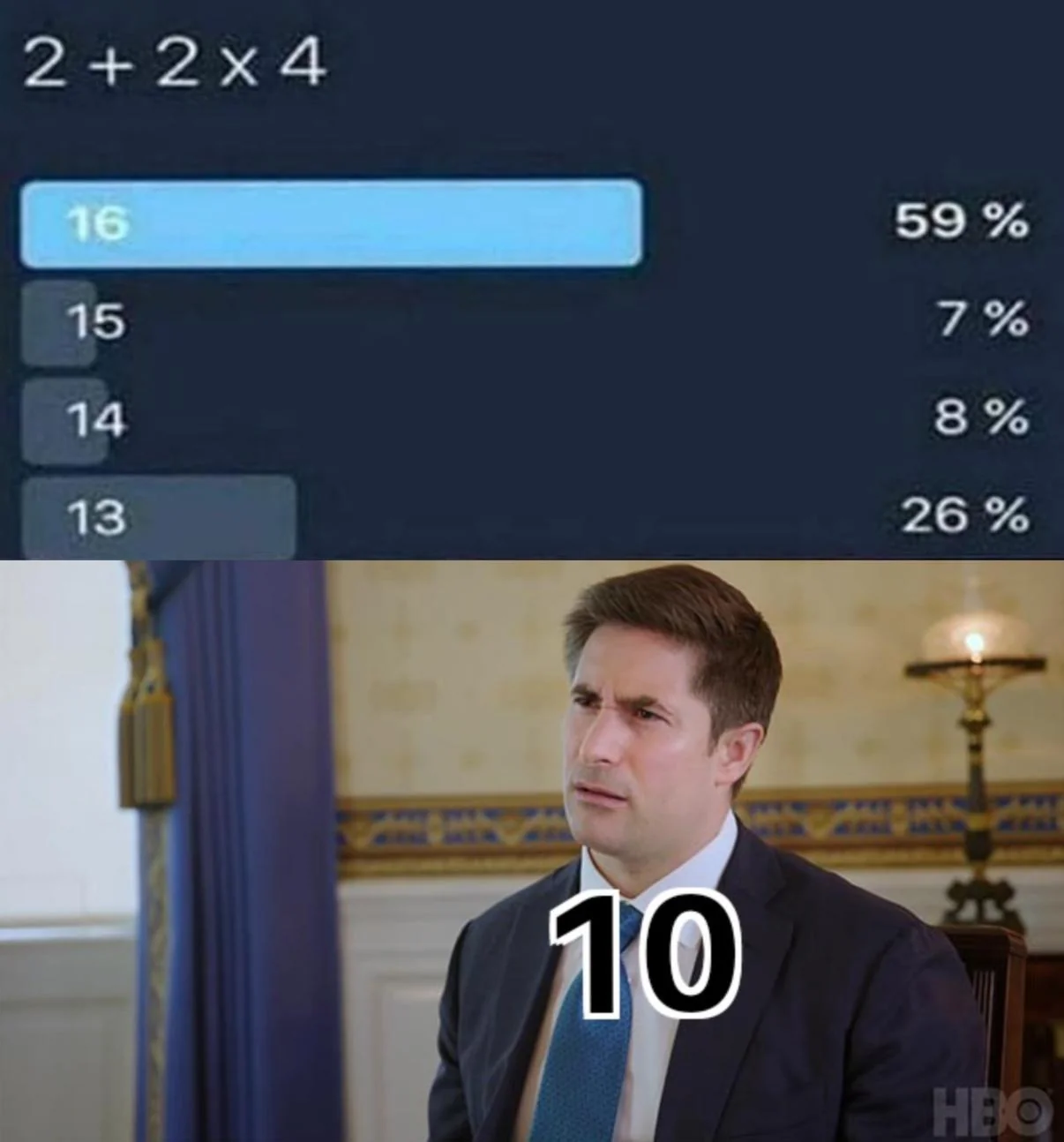
I mean, obviously ten.

But I at least understand 16.

I deeply worry about the percentage just next to the other three numbers.

  • source
  • hideshow 51 child comments
  • [–] 98 points 10 months ago

    13 is probably the next most chosen because it’s closest to 10.

    Not including the correct answer is also a form of engagement bait to get additional comments and such saying “wait the real answer is 10, wtf?”

  • source
  • parent
  • [–] 11 points 10 months ago (5 children)

    Why worry? You can see them on the right side of the image

  • source
  • parent
  • hideshow 5 child comments
  • [–] 9 points 10 months ago (4 children)

    It not even remotely possible to make an odd number out of that.

    The numbers on the right-hand side are what I'm actually working about.

  • source
  • parent
  • hideshow 4 child comments
  • [–] 13 points 10 months ago (3 children)

    I was trying yo make a shitty joke conflating you worrying (having concern) with you worrrying (wondering what).

  • source
  • parent
  • hideshow 3 child comments
  • [–] -1 points 10 months ago (41 children)

    Your obviously is only a convention and not everyone agree with that. Not even all peogramming languages or calculators.

    If you wanted obviously, it would have to have different order or parentheses or both. Of course everything in math is convention but I mean more obvious.

    2+2*4 is obvious with PEDMAS, but hardy obvious to common people

    2+(2*4) is more obvious to common people

    2*4+2 is even more obvious to people not good with math. I would say this is the preferred form.

    (2*4)+2 doesn't really add more to it, it just emphasises it more, but unnecessarily.

  • source
  • parent
  • hideshow 41 child comments
  • [–] 9 points 10 months ago (15 children)

    Honestly that’s my pet peeve about this category of content. Over the years I’ve seen (at least) hundreds of these check-out-how-bad-at-math-everyone-is posts and it’s nearly always order of operations related. Apparently, a bunch of people forgot (or just never learned) PEMDAS.

    Now, having an agreed-upon convention absolutely matters for arriving at expected computational outcomes, but we call it a convention for a reason: it’s not a “correct” vs “incorrect” principle of mathematics. It’s just a rule we agreed upon to allow consistent results.

    So any good math educator will be clear on this. If you know the PEMDAS convention already, that’s good, since it’s by far the most common today. But if you don’t yet, don’t worry. It doesn’t mean you’re too dumb to math. With a bit of practice, you won’t even have to remember the acronym.

  • source
  • parent
  • hideshow 15 child comments
  • [–] 6 points 10 months ago (8 children)

    Most actual math people never have to think about pemdas here because no one would ever write a problem like this. The trick here is "when was the last time I saw an X to mean multiplication" so I would already be off about it

    1 + 1/2 in my brain is clearly 1.5, but 1+1÷2 doesn't even register in my brain properly.

  • source
  • parent
  • hideshow 8 child comments
  • [–] 4 points 10 months ago* (last edited 10 months ago) (2 children)

    Right, and that clue IMO unravels the more troubling aspect of why this content spreads so quickly:

    It’s deliberately aimed at people with a rudimentary math education who can be made to feel far superior to others who, in spite of having roughly the same level of proficiency, are missing/forgetting a single fact that has a disproportionate effect on the result they expect.

    That is, it’s blue-dress-level contentious engagement bait for anyone with low math skills, whether or not they remember PEMDAS.

  • source
  • parent
  • hideshow 2 child comments
  • [–] 0 points 10 months ago (4 children)

    no one would ever write a problem like this

    And yet Maths textbooks do! 😂

    when was the last time I saw an X to mean multiplication

    In a Maths textbook

    1+1÷2 doesn’t even register in my brain properly

    You don't know that the obelus means divide??

  • source
  • parent
  • hideshow 4 child comments
  • [–] 0 points 10 months ago (3 children)

    And yet Maths textbooks do! 😂

    "No one" in this context meant "no one who actually does maths professionally."

    In a Maths textbook

    Right, and I have decades of maths experience outside of textbooks. So it's probably been 20 years since I had a meaningful interaction with the × multiplication symbol.

    You don’t know that the obelus means divide??

    I clearly know what the symbol means, I demonstrated a use of it. But again, haven't had a meaningful interaction with the symbol in 20 years, and yet I deal with / for division daily.

    When I see 1+½ i can instantly say "one and a half", but when I see 1 + 1 ÷ 2 i actually have to pause for a moment to think about order of operations. Same with 1+2x vs 1 + 2 × x ... one I recognize the structure of the problem immediately, and one feels foreign.

    The point is that people who do maths for a living, and are probably above average in maths, tend to write things differently than people who are stopped their maths education in high school (or lower), and these types of memes are designed around making people who know high school maths feel smart. People who actually know maths don't need memes to justify being better at maths than the rest of the public.

  • source
  • parent
  • hideshow 3 child comments
  • load more comments (3 replies)
  • [–] 0 points 10 months ago (4 children)

    having an agreed-upon convention absolutely matters for arriving at expected computational outcomes,

    Proven rules actually

    we call it a convention

    No we don't - the order of operations rules

    it’s not a “correct” vs “incorrect” principle of mathematics

    The rules most definitely are

    It’s just a rule we agreed upon to allow consistent results

    proven rules which are true whether you agree to it or not! 😂

    any good math educator will be clear on this

    Yep

    If you know the PEMDAS convention already, that’s good, since it’s by far the most common today

    No it isn't.

    But if you don’t yet, don’t worry

    As long as you know the rules then that's all that matters

  • source
  • parent
  • hideshow 4 child comments
  • [–] 1 point 10 months ago (3 children)

    Dear Mr Rules,

    I’m not sure what motivates you to so generously offer your various dyadic tokens of knowledge on this subject without qualification while ignoring my larger point, but will assume in good faith that your thirst for knowledge rivals that of your devotion to The Rules.

    First, a question: what are conventions if not agreed upon rules? Second, here is a history of how we actually came to agree upon the aforementioned rules which you may find interesting:

    https://www.themathdoctors.org/order-of-operations-historical-caveats/

    Happy ruling to you.

  • source
  • parent
  • hideshow 3 child comments
  • [–] 0 points 10 months ago (2 children)

    knowledge on this subject without qualification

    I'm a Maths teacher with a Masters - thanks for asking - how about you?

    while ignoring my larger point

    You mean your invalid point, that I debunked?

    what are conventions if not agreed upon rules?

    Conventions are optional, rules aren't.

    here is a history of how we actually came to agree upon the aforementioned rules which you may find interesting

    He's well-known to be wrong about his "history", and if you read through the comments you'll find plenty of people telling him that, including references. Cajori wrote the definitive books about the history of Maths (notation). They're available for free on the Internet Archive - no need to believe some random crank and his blog.

  • source
  • parent
  • hideshow 2 child comments
  • [–] 0 points 10 months ago (1 child)

    Dear colleague,

    By qualification I meant explanation. My doctorate is irrelevant to the truth.

    Since you asked, my larger point was about the unhelpful nature of this content, which makes students of math feel inordinately inferior or superior hinged entirely on a single point of familiarity. I don’t handle early math education, but many of my students arrive with baggage from it that hinders their progress, leading me to suspect that early math education sometimes discourages students unnecessarily. In particular, these gotcha-style math memes IMO deepen students’ belief that they’re just bad at math. Hence my dislike of them.

    Re: Dave Peterson, I’ll need to read more about this debate regarding the history of notation and I’ll search for the “proven rules” you mentioned (proofs mean something very specific to me and I can’t yet imagine what that looks like WRT order of operations).

    If what riled you up was my use of the word “conventions” I can use another, but note that conventions aren’t necessarily “optional” when being understood is essential. Where one places a comma in writing can radically change the meaning of a sentence, for example. My greater point however has nothing to do with that. Here I am only concerned about the next generation of maths student and how viral content like this can discourage them unnecessarily.

  • source
  • parent
  • hideshow 1 child comment
  • [–] 1 point 9 months ago

    My doctorate is irrelevant to the truth

    It sure is. I've seen a PhD who didn't read the only textbook he had referenced in his thesis, which proved his idea that teachers were doing it wrong and he wasn't, was wrong. 😂 Should've listened to the people who teach it (or actually read the textbook he referenced 🙄 ).

    which makes students of math feel inordinately inferior

    They don't. All students get this correct. It's only adults who have forgotten the rules that get it wrong.

    these gotcha-style math memes IMO deepen students’ belief that they’re just bad at math

    Nope. Students never get these wrong.

    proofs mean something very specific to me and I can’t yet imagine what that looks like WRT order of operations

    All you have to do is see which way gives wrong answers for 2+3x4 and you've proven which ways don't work 😂

    note that conventions aren’t necessarily “optional”

    Yes they are.

    when being understood is essential

    You don't understand how to do 2+3x4-5 without knowing which conventions people use for the order of the plus and minus?

    Here I am only concerned about the next generation of maths student and how viral content like this can discourage them unnecessarily

    It doesn't. None of them get it wrong. 🙄

  • source
  • parent
  • [–] 4 points 10 months ago

    I feel like people should at least remember math at a 4th grade level and be able to get 10. What is the point of making it obvious the universe will never ever arrange itself in such a fashion. The point is if you remember simple rules you applied for a 10-15 years.

  • source
  • parent
  • [–] 3 points 10 months ago

    common people who are not good at math...

    PEMDAS is in the 5th-grade curriculum.

    My obviously is gated to people who can hadle 5th-grade math.

    I would say we should not provide the mathematically illiterate any say in the matter. They need to spend 10 minutes on Youtube and learn it.

  • source
  • parent
  • [–] 1 point 10 months ago (3 children)

    PEMDAS isn't obvious to "common people"? Why not? It doesn't seem like an arbitrary convention to me...

    If "×" means "groups of," then "2+2×4" means "two plus two groups of four" which only makes sense, to me, to be read as "two plus two groups of four" rather than "two plus two groups of four"

    Sure the order of operations could be arbitrarily different, but I feel like we settled on that order because it simply makes more sense intuitively.

    I'm aware of the possibility that it only feels natural and intuitive to me because I was taught that way, but I at least don't think that applies to this specific example

  • source
  • parent
  • hideshow 3 child comments
  • [–] 2 points 10 months ago

    PEMDAS isn’t obvious to “common people”?

    Everyone is taught the rules of Maths

    If “×” means “groups of,”

    It means repeated addition actually

    “2+2×4” means “two plus two groups of four”

    No, it means 2+2+2+2+2

    Sure the order of operations could be arbitrarily different

    No they can't

    I feel like we settled on that order because it simply makes more sense intuitively

    It's because Multiplication is defined as repeated addition, so if you don't do it before addition you get wrong answers

  • source
  • parent
  • [–] 1 point 10 months ago (1 child)

    PEMDAS isn't obvious to "common people"? Why not?

    Clearly not if most of these answers are incorrect. If it was obvious, there wouldn't be as many answers as there are.

  • source
  • parent
  • hideshow 1 child comment
  • [–] 1 point 10 months ago (13 children)

    There's just 5 lots of 2. If it's hard then think of x being just a bunch of + smooshed together. So

    2 + 2 x 4

    expands to

    2 + 2 + 2 + 2 + 2

    or contracts to

    5 x 2

  • source
  • parent
  • hideshow 13 child comments
  • [–] 2 points 10 months ago (12 children)

    You've completely not understood that order of operations is an arbitrary convention. How did you decide to expand the definition of multiplication before evaluating the addition? Convention.

    You can't write 2 + 2 ÷ 2 like this, so how are you gonna decide whether to decide to divide or add first?

  • source
  • parent
  • hideshow 12 child comments
  • [–] 1 point 10 months ago (11 children)

    You’ve completely not understood that order of operations is an arbitrary convention

    No, you've completely not understood that they are universal rules of Maths

    How did you decide to expand the definition of multiplication before evaluating the addition? Convention

    The definition of Multiplication as being repeated addition

    You can’t write 2 + 2 ÷ 2 like this

    Yes you can

    so how are you gonna decide whether to decide to divide or add first?

    The rules of Maths, which says Division must be before Addition

  • source
  • parent
  • hideshow 11 child comments
  • [–] 0 points 10 months ago (10 children)

    How are you gonna write 2 + 2 ÷ 2 with repeated addition?

    The definition of Multiplication as being repeated addition

    That doesn't mean it has to be expanded first. You could expand 2 + 2 × 3 as (2+2)+(2+2)+(2+2) and you are unable to tell me what mathematical law prohibits it.

    If this were a universal law, reverse polish notation wouldn't work as it does. In RPL, 2 2 + 3 × is 12 but 2 3 × 2 + is 8. If you had to expand multiplication first, how would it work? The same can be done with prefix notation, and the same can be done with "pre-school" order of operations.

    Different programming languages have different orders of operations, and those languages work just fine.

    Your argument amounts to saying that it makes the most sense to do multiplication before addition. Which is true, but that only gives you a convention, not a rule.

  • source
  • parent
  • hideshow 10 child comments
  • [–] 0 points 9 months ago (9 children)

    How are you gonna write 2 + 2 ÷ 2 with repeated addition?

    You don't, because the second 2 is associated with a Division that has to be done before the addition. Maybe go back to school and learn how to do Maths 🙄

    That doesn’t mean it has to be expanded first.

    Yes it does. Everything has to be expanded before you do the addition and subtraction, or you get wrong answers 🙄

    2+3x4=2+3+3+3+3=2+12=14 correct

    2+3x4=5x4=5+5+5+5=20 wrong

    You could expand 2 + 2 × 3 as (2+2)+(2+2)+(2+2)

    Says someone who can't tell the difference between (2+2)x3=12 and 2+2x3=8 🙄

    you are unable to tell me what mathematical law prohibits it

    The order of operations rules 😂

    reverse polish notation wouldn’t work as it does

    It works because it treats every operation as bracketed without writing the brackets. Also that's only a Maths notation, not the Maths itself.

    In RPL, 2 2 + 3 × is 12

    Because the way it calculates that is (2+2)x3, not complicated. Same order of operations rules as other Maths notations - just a different way of writing the same thing

    If you had to expand multiplication first, how would it work?

    It works because Brackets - 2 2 + = (2+2) - are before Multiplication

    The same can be done with prefix notation

    Another Maths notation, same rules of Maths

    Different programming languages have different orders of operations

    Maths doesn't

    those languages work just fine

    They don't actually. Welcome to most e-calcs give wrong answers because the programmers failed to deal with it correctly.

    Your argument amounts to saying that it makes the most sense to do multiplication before addition

    No, my argument is it's a universal rule of Maths, as found in Maths textbooks 🙄

    that only gives you a convention, not a rule

    Left to right is a convention (as is not writing the brackets in RPN). Brackets before Multiplication before Addition are rules.

  • source
  • parent
  • hideshow 9 child comments
  • load more comments (9 replies)
  • [–] 0 points 10 months ago (2 children)

    Your obviously is only a convention

    Nope. Rules of Maths

    it would have to have different order or parentheses or both.

    Neither. Multiplication is always before Addition, hence "obviously"

    Of course everything in math is convention

    Nope. The vast majority of it is proven rules

    2+(2*4) is more obvious to common people

    Weird then how many people were able to get this right without brackets for centuries before we started using brackets in Maths (which we've only had for 300 years)

  • source
  • parent
  • hideshow 2 child comments
  • [–] 1 point 10 months ago (1 child)

    Tell that obvious to over half the population who get this wrong

  • source
  • parent
  • hideshow 1 child comment
  • [–] 0 points 9 months ago

    Tell that obvious to over half the population who get this wrong

    Way less than half actually. No teachers or students ever get this wrong, only adults who have forgotten the rules, and poll after poll puts this down around 40-45% of adults.

  • source
  • parent