you are viewing a single comment's thread
view the rest of the comments
[–] 235 points 1 week ago (72 children)

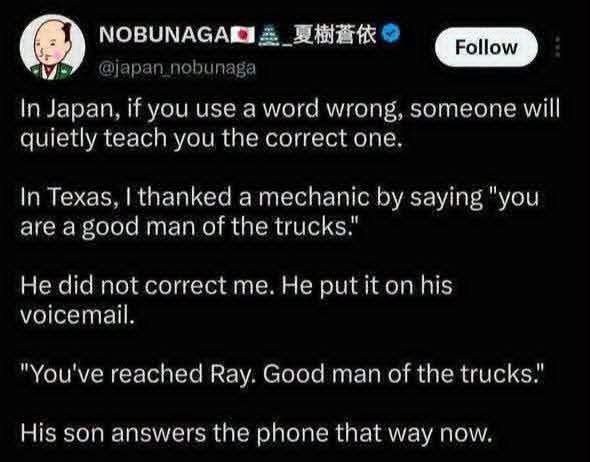
One nice thing about English, it will lexical borrow from you in an instant.

We just love new ways to say old boring stuff.

  • source
  • hideshow 72 child comments
  • [–] 4 points 6 days ago

    Sometimes it gets so ingrained into English that it feels natural.

    好久不见 (hǎo​ jiǔ ​bu ​jiàn), lit. long time no see, it's originally a Chinese phrase that became commonplace in English. Even though it doesn't quite hold up grammatically in English, no one will question it.

  • source
  • parent
  • [–] 132 points 1 week ago (57 children)

    I have been saying it for years, English is a very informal and open language, have fun with it. Sky water is not technically a wrong way to refer to rain, liquid laundry soup is absolutely a sauce for your laundry, dish bricks, day star, the list goes on

  • source
  • parent
  • hideshow 57 child comments
  • [–] 88 points 1 week ago (22 children)

    I think this is one of the reasons why English (or it's descendants) will forever be the international language of trade. If it's not your first language, it's damn difficult to make yourself sound like a native speaker, but it's damn easy to make yourself understood.

  • source
  • parent
  • hideshow 22 child comments
  • [–] 12 points 1 week ago (15 children)

    On the flip side, a lot of other languages have retained structures which require a detailed knowing of grammar in part because they haven't needed to be learned by amateurs.

  • source
  • parent
  • hideshow 15 child comments
  • [–] 21 points 1 week ago (4 children)

    True, though I would personally count that as a bad thing. Purity of language, to me is irrelevant. That opinion may be coloured by the fact that I'm a native English speaker, and there hasn't been anything resembling purity in this language for thousands of years. To me, the point of language is open communication. Any impediment to that is a negative.

  • source
  • parent
  • hideshow 4 child comments
  • [–] 9 points 1 week ago* (3 children)

    I lik your way of doyng byzness

  • source
  • parent
  • hideshow 3 child comments
  • [–] 5 points 1 week ago*

    I speak several languages, most of which are Romance languages (such as French and Italian) which have a specific word order which pretty close to english (though adjective come after nouns rather than before, plus there are some additional verbal times though those are uncommon to use).

    Amongst those I also speak Dutch and German, which have quite a different word order (though, curiously, Dutch from Belgium has a similar word order to French) and I constantly fuck it up (especially in German, which is the one of the two I speak worse) and the natives always understand me.

    In my experience learning two of those languages just by living there (and with people that are learning my own native language), it's using the wrong words that confuses people, then using the wrong accent (mainly by putting the emphasis in the wrong syllable) and only as a far third is word order and even that only in specific cases such expressions (where it's the whole expression as is that has a meaning, rather the meaning being a composition of the meaning of the individual words in it).

    In my experience there really is no special quality of the English language that makes it easier to understand when people use a wrong word order.

  • source
  • parent
  • load more comments (6 replies)
  • [–] 9 points 1 week ago (4 children)

    I think you're confusing a reasonably short period in recent history with "forever".

    In History there were quite a lot of "international languages of trade" other than English. It seems to depend very much on which nations were the top empire of the age and because the last two top empires were English-speaking countries (first Britain, then after that the United States), the English language has been dominant as a second language for a over a century now, but before that the English language already existed in a form very similar to the modern form and yet it wasn't at all an "international language of trade" (in fact, at least in Europe, before English it was French that was the dominant language of trade).

    I bet that the next "international language of trade" will be Chinese.

  • source
  • parent
  • hideshow 4 child comments
  • load more comments (4 replies)
  • [–] 16 points 1 week ago (11 children)

    I remember an interview with Lisa Kudrow in which she described her French boyfriend's failure to remember the English word for toes, and said they were foot fingers.

    English: if the people you're talking to understand what you're saying, you're ok. Even if the people you're talking to don't understand what you're saying, you're still ok. Just be fancy with your words, and everyone will like it.

  • source
  • parent
  • hideshow 11 child comments
  • [–] 12 points 1 week ago (7 children)

    In french, that's really the name that is given to them, colloquially : doigts de pied (foot fingers)

    The real term is orteils (toes)

  • source
  • parent
  • hideshow 7 child comments
  • [–] 5 points 1 week ago (5 children)

    They're really good at it, too. Sometimes it's even charming. For example, potatoes are "earth apples."

  • source
  • parent
  • hideshow 5 child comments
  • [–] 5 points 1 week ago (3 children)

    I wonder if the meaning of pomme was broader in Old French, like how meat (from mete) used to mean food in Old English.

  • source
  • parent
  • hideshow 3 child comments
  • [–] 5 points 1 week ago

    Yes it was the case, broadly pomme meant fruit.

    Originally tomatoes were called pommes d'amour. There is pommes de terre (potatoes) pommes de pin (pinecones). If we would translate literally pomme de pin it would give us pineapple.

    There were also other fruits beginning with pomme originally but I can't seem to recall them.

  • source
  • parent
  • load more comments (2 replies)
  • [–] 3 points 1 week ago* (last edited 1 week ago)

    It's the same in Dutch - "aardapple" - but using the Dutch words for earth and apple rather than the French ones.

    And don't get me started on French numbering - for example 98 is "four twenties eigtheen".

    One doesn't get it for one's own language because all the weird stuff is "normal" but when you're learning other languages you discovered they're all riddled with funny constructs like this (and then there are expressions, which are often hilarious - for example on of the Dutch expression for wasting time on small details literally translates to "fucking ants")

  • source
  • parent
  • load more comments (1 reply)
  • [–] 3 points 1 week ago* (3 children)

    Not sure what a dish brick is, but yeah, the others make sense 👍

    Edit: just figured it out: it's a Lego piece shaped like a dish

  • source
  • parent
  • hideshow 3 child comments
  • load more comments (14 replies)
  • [–] 28 points 1 week ago (8 children)

    Ironically, same with Japanese. They have an entire alphabet dedicated to foreign words, Katakana. You want a hamburger and a beer? That's a "ハンバーガーとビール" (Hanbāgā to Biru). Coffee from Starbucks on your way to work? That's a "ドライブスルーコーヒー" (Doraibusurūkohi - a drive-thru coffee). Better fried chicken than anyone has a right to can be found at the "コンビニ" (Konbini - aka the convenience store). Learning Japanese it's rife with these borrowed words. Half the time it's "you're fucking kidding." The other half the time it's learning some insane formalism that makes saying "thank you" take five minutes.

  • source
  • parent
  • hideshow 8 child comments
  • [–] 10 points 1 week ago* (1 child)

    What's cool is how English then adds those loanwords or portmanteau back into its lexicon like karaoke or, as I'm seeing more recently, egg sando. I really love how languages do that.

  • source
  • parent
  • hideshow 1 child comment
  • [–] 3 points 1 week ago (2 children)

    Awhile back, I watched an anime about camping. It was chill, and cute, and I enjoyed it. But every time they stopped to discuss some kind of camping equipment, it was all English loan words, and it drove me a bit bonkers.

    What do you mean Japanese just straight up borrowed the phrase "ground tarp" from English??? Surely they already have words for that!

  • source
  • parent
  • hideshow 2 child comments
  • [–] 3 points 1 week ago*

    I'm learning Korean, in South Korea they use so much English vocabulary and it's all spelled phonetically, for example table (yes they use that word) becomes 테이블 (teibeul) and then you have to pronounce it like a Korean word which always sounds a little weird. Japanese is similar, but the possible syllables in Japanese are much more limited so it ends up sounding even weirder and sometimes isn't immediately recognisable as English.

  • source
  • parent
  • [–] 3 points 1 week ago

    They may have. Several Japanese words for everyday objects are taken from other languages despite having earlier words for those things. E.g. bread is pan (from Portuguese) and ball is boru (English).

    Though my personal favorite is black hole. Despite having different words for black and hole, black hole is translated as burakkuhoru

  • source
  • parent
  • load more comments (1 reply)